How to Read a Japanese Tableware Listing: Sizes, Materials, and What the Silences Mean
A teapot listed at 300 ml that pours two cups and stops. An 8-gō donabe that turns out to be two centimetres narrower than your friend’s 8-gō donabe. A plate whose size is given in a unit you can’t convert, from a place you can’t find on a map, with nothing written anywhere about the microwave.
None of that is dishonest. It is a translation that went one word at a time. Japanese product pages are written for readers who already know the conventions; translating the words preserves the vocabulary and drops the conventions, which is where all the information lives.
One fact underneath the rest of this guide. Japan’s household-goods quality labelling law names particular product categories that must carry particular fields on the label. Tableware coated in lacquer or cashew resin is on that list — which is why a lacquer bowl states its base material and its coating type in a fixed format, and why you can read a lacquer listing like a spec sheet. Reinforced and borosilicate glass vessels are on it too. Ceramic tableware is not.
So there is no required field on a ceramic page. Every number is a trade convention rather than a specification, and every gap is a choice someone made — usually the choice not to test. You read the page in two passes: convert the numbers, then read the silences.
The size is already in the name
Most Japanese plates carry their diameter in their product name, in a unit that predates the metric system and never left the pottery trade. One sun (寸) is 3.03 cm — from the old shakkanhō system, and originally about the width of a thumb. Once you know that, half the catalogue decodes itself: a 5-sun plate is 15.1 cm, a 7-sun plate is 21.2 cm, and a shaku (尺, ten sun) platter is 30.3 cm.
Two cautions before you trust the number. It is the widest outside diameter, rim included — so a 7-sun plate with a 3 cm sloping rim gives you about the food surface of a 5-sun plate, which is why a stack of “large” plates can turn out to seat a very small dinner. And on square, oval and leaf shapes the figure almost always refers to the long side, so the piece is narrower than the number in every other direction.
The gō (号) on a clay pot works differently, and this is where people get caught. It broadly tracks size — an 8-gō donabe is typically quoted at a 23–25 cm mouth, three to four people, one to three litres — but there is no fixed definition behind it, so two makers’ 8-gō pots are genuinely different pots, and depth varies more than width does. Skip the gō and look for kōkei (口径), the mouth diameter, in centimetres. If a donabe listing gives you only a gō number, it has told you almost nothing.
Then there is volume, which is the quietest trap on the page. Japanese listings quote mansui yōryō (満水容量), brim-full capacity: the volume the vessel holds if you fill it to the very edge. The usable figure is roughly 70 per cent of that. So a kyusu listed at 300 ml brews about 210 ml of tea, and a yunomi listed at 200 ml is a 140 ml cup in daily use. This is the single most common reason a Japanese teapot arrives feeling smaller than advertised. It is also the reason to buy the pot one size up from the arithmetic you did in your head.
The material line, and the trade’s own honest words
Four words do most of the work here: 磁器 (jiki, porcelain), 陶器 (tōki, earthenware), 炻器 (sekki, stoneware) and 半磁器 (hanjiki, semi-porcelain). But Japanese shops often use an older pair that says more in two syllables: 石物 (ishimono, “stone things”) and 土物 (tsuchimono, “earth things”). Stone things are vitrified and closed — they don’t absorb, they don’t stain, they don’t much care. Earth things are porous: they take on water, they darken where they are used, and they want seasoning and thorough drying. Everything about living with a piece follows from which side of that line it sits on, and the regional styles sort along the same axis.
Hanjiki is the word to slow down at. It’s a real category rather than a hedge, but it sits between the two, and shops reach for it when a piece looks like porcelain and behaves partly like earthenware. If the material line says hanjiki and the care line says nothing at all, assume the care of the earthier one and you will never be disappointed.
One more term worth recognising because it reads like a defect warning and isn’t: 貫入 (kannyū), the fine crackle in the glaze. When a listing declares kannyū, it is describing an intended surface that will slowly take on colour with use. It is a feature note, not an apology.
The decoration line, or: what will still be there in ten years
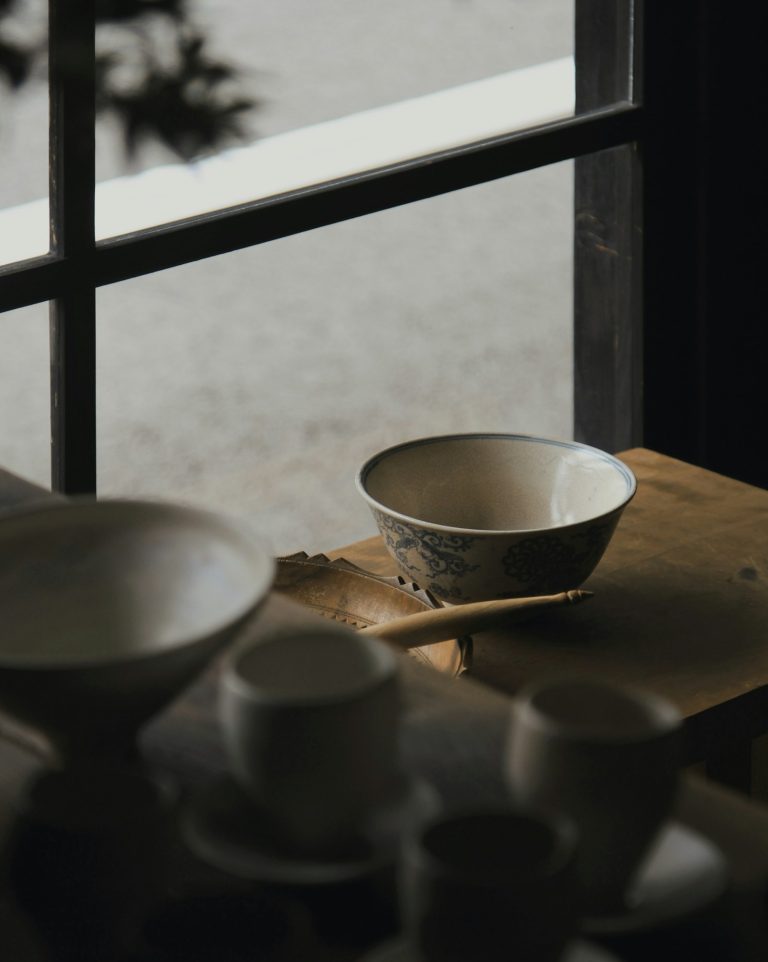
Two words split the whole category. 下絵付 (shita-etsuke) is painted onto the biscuit and then sealed under the glaze; 上絵付 (uwa-etsuke) is painted on top of the fired glaze and re-fired cooler. Underglaze is protected by a layer of glass and effectively permanent — sometsuke (染付), the familiar cobalt blue, is the classic case. Overglaze can be far more colourful, because low-temperature pigments survive that a high firing would burn away, and it is physically exposed, so it wears at the points a sponge visits most.
Then: was it painted, or printed? 手描き (tegaki) means hand-painted. 転写 (tensha) and 印判 (inban) mean transfer-printed — a technique that entered Japanese production in the Meiji period via copper-plate printing, and the reason identical hand-drawn-looking bowls exist by the hundred.
You can usually tell from the shop’s own photographs. Hand-painted overglaze has physical relief: the pigment stands slightly proud of the glaze, so it catches the light along one edge, and a brushed line starts heavy and finishes thin. A transfer is dead flat and exactly the same weight everywhere along its length. Best test of all — if the listing shows three pieces and the pattern lands in the identical position on all three, it’s a transfer. That is not a reason to walk away. Transfers are how a genuinely good everyday bowl costs $8 instead of $60. It is only a reason not to pay the $60.
Finally, 金彩 and 銀彩 — gold and silver overglaze. This is the one decoration that removes an option rather than adding one: metallic overglaze can’t go in a microwave, and it is the first thing to wear at the rim. The maker’s own instruction always wins over any general rule, and the reasoning behind the rule is worked through in our microwave and dishwasher guide.
The place name is a place, not always a style
“○○焼” means “ware fired at ○○.” Several of these names are registered regional collective trademarks in Japan, which makes them origin claims rather than aesthetic ones — and that distinction has a history worth knowing.
For decades, porcelain made in Hasami, in Nagasaki, was finished and shipped through neighbouring Arita in Saga and sold as Arita-yaki. When origin labelling across Japanese industries tightened in the 2000s, that stopped, and Hasami-yaki became its own name on its own pages. Same kilns, same quality, different word — and, because the word was new, generally a lower price. If you are shopping for everyday porcelain and you find yourself choosing between the two, that history is the whole answer.
Mino-yaki, meanwhile, is closer to a postcode than a look: the Mino region accounts for roughly half of all Japanese tableware production, and its named styles range from thick white Shino to deep green Oribe. “Mino-yaki” on a listing tells you where, not what.
And the country question. Read whether the page says where the piece was made — 日本製 (Nihon-sei) — or only that the brand, the design or the company is Japanese. Both are legitimate; they are just not the same sentence, and a page that means the first one almost always says it plainly.
A short dictionary for the fields you’ll actually meet
| On the page | Reading | Literally | What it changes for you |
|---|---|---|---|
| 径 / 口径 | kei / kōkei | diameter / mouth diameter | The number to trust. Outside edge, rim included. |
| 高 / 高さ | takasa | height | Decides whether it stacks and whether it fits your shelf. |
| 満水容量 | mansui yōryō | brim-full capacity | Multiply by ~0.7 for the volume you will actually use. |
| 磁器 / 陶器 / 炻器 | jiki / tōki / sekki | porcelain / earthenware / stoneware | Porous or not — which sets all care from day one. |
| 土物 / 石物 | tsuchimono / ishimono | earth things / stone things | The trade’s blunter version of the same split. |
| 下絵付 / 上絵付 | shita-etsuke / uwa-etsuke | under- / over-glaze | Permanent, or exposed and able to wear. |
| 手描き / 転写・印判 | tegaki / tensha, inban | hand-painted / transfer-printed | Mostly a price question. Judge the piece, then the price. |
| 金彩 / 銀彩 | kinsai / ginsai | gold / silver decoration | Rules out the microwave; wears at the rim first. |
| 貫入 | kannyū | crazing | Intended. It will take on colour with use. |
| 個体差 | kotaisa | individual variation | Expect it, and expect to like it. Sets are not identical. |
| 日本製 | Nihon-sei | made in Japan | An origin claim. “Japanese brand” is a different one. |
| 電子レンジ可 / 食洗機可 | denshi renji ka / shokusenki ka | microwave OK / dishwasher OK | Only meaningful when present. Absence says nothing. |
Reading the silences
No microwave or dishwasher line. This is the omission people over-read in both directions. It is not permission and it is not a prohibition. Since nothing is required on a ceramic page, most small makers simply don’t test and don’t write. Treat unknown as unknown, follow whatever instruction does arrive in the box, and if you want to reason about a piece already in your cupboard, that’s a separate question with a separate method.
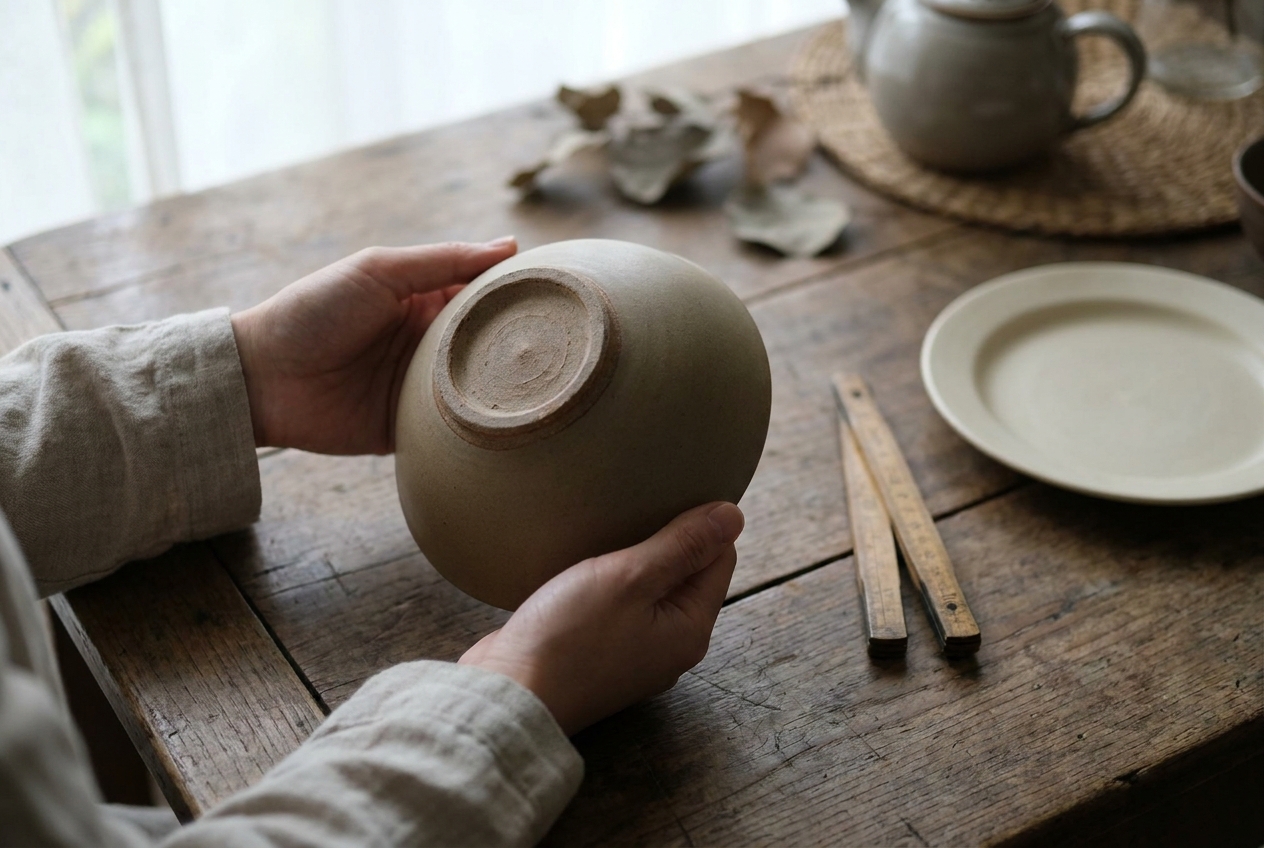
No photograph of the base. The foot ring is the one place the body shows through unglazed, and it answers the material question faster than any product copy — which is why reading the foot is the first thing to learn. A shop that doesn’t photograph the base isn’t concealing anything. It has just left out the single most informative view.
No weight. Weight is what decides whether a rice bowl becomes the one you reach for or the one at the back. A listed weight is a small sign that the shop expects to be judged on use rather than on photography.
No variation notice on something sold as handmade. The standard sentence — 一点ずつ手作りのため、色・形に個体差がございます — is the norm on genuinely handmade goods. When it is missing from a piece described as handmade, either it is mould-made, or the description was written from a template. Neither is fatal. Both are information you now have for free.
A set price with no per-piece dimension. This is common on small-dish sets and on serving plates, where the pieces in the photograph are wildly different sizes and only one number is given. Ask, or assume the smallest plausible reading.
Buy this, not that
Buy from the listing that gives you 径 or 口径 in centimetres, a photograph of the base, and a weight — even when it’s plainer than the rival page with five styled shots and no numbers. A shop that publishes numbers expects to be judged on use. Don’t make a gold- or silver-rimmed piece your first weekday bowl: it costs you the microwave permanently and wears at the rim first, and for daily use a plain porcelain 5-sun plate at $12–25 will outlast it. And don’t pay hand-painted prices for a page showing six pieces with the pattern in the identical position — that’s a transfer, and a good transfer is worth roughly $8–20, not $60.
Sixty seconds before you click buy
- Convert the name. Any sun figure × 3.03 = centimetres. Any gō figure — ignore it, find kōkei.
- Multiply any capacity by 0.7 and decide again whether the size is right.
- Find the material word. If it isn’t there, look at the base photograph. If there is no base photograph, that is your answer about the shop.
- Decide what you are paying for: form, or decoration. If it’s decoration, work out whether it was painted or printed before agreeing the price.
- Read the place name as origin, not style — then check whether the page says made in Japan or merely Japanese.
- List what the page never mentions. Weight, base, microwave, variation. Each gap is a question you can send the shop, and good shops answer.
None of this makes you an expert, and it isn’t meant to. It gets you to the point where the page stops being decorative and starts being evidence — where you can look at two nearly identical white plates, thirty dollars apart, and say precisely what the thirty dollars is buying. Sometimes it’s a hand-painted line that will still be there in ten years. Sometimes it’s a photograph.
The listing was never trying to fool you. It was talking to someone who already knew. From here, the pieces themselves: the shape of the Japanese table, which region made what and why it matters, the donburi and the ramen bowl people confuse it with, the cast-iron kettle that follows none of these conventions, and what happens when a piece finally breaks.
Disclosure: Nagori Ware is an independent editorial guide written from Japan. Some links elsewhere on the site are affiliate links. Parts of this site are drafted with AI assistance and checked against Japanese sources. The photograph is AI-generated and illustrative. General information, not legal or safety advice. Terminology and conventions described here reflect common Japanese retail practice and are not legal advice; where a maker’s or shop’s own labelling, instructions or care guidance differ from anything written here, follow theirs.