Japanese Tableware Sizes & Terms: A Reference
This is a reference page. Most guides to Japanese pottery translate the words; almost none translate the measurements — and the measurements are where buyers abroad get surprised: a bowl smaller than expected, a “300ml” teapot that pours two thirds of that, two pots both sold as “8-gō” that are visibly different sizes. None of it is dishonest. It is a different convention. Here is the conversion key.
Plate sizes: the sun (寸)
Japanese dishes are still sold in sun (寸). One sun is 3.03 cm — a traditional unit, not a rounded metric one, so the centimetre figures look oddly specific. A “7-sun plate” is 21.2 cm, not 21 or 20. Two things trip buyers up: the figure is the maximum outer diameter including the rim (the usable well is smaller), and square or rectangular pieces are given by their long edge. The deeper pieces that hold a full meal follow the same logic — see our guides to donburi bowls and Japanese rice bowls.
| Sun (寸) | Centimetres | Typical use |
|---|---|---|
| 3–3.5寸 | 9–10.6 cm | Mamezara (bean dish), soy dipping dish |
| 5寸 | 15.2 cm | Rice bowl saucer, small-plate mainstay (kozara) |
| 6寸 | 18.2 cm | Cake / bread plate, side dish |
| 7寸 | 21.2 cm | The everyday workhorse plate |
| 8寸 | 24.2 cm | Main-course / pasta plate |
| 尺 (10寸) | 30.3 cm | Platter, shared serving dish |
Pot & donabe sizes: the gō (号)
Clay pots (donabe) and many planters are sized in gō (号). Here is the catch no listing warns you about: gō has no fixed definition for donabe. It roughly tracks mouth diameter, but the litres and the servings vary between makers. An “8-gō” pot from one workshop and another can differ by a full portion. Ignore the gō number and read the mouth diameter in centimetres and the litre capacity.
| Gō (号) | Mouth ø | Capacity | Serves |
|---|---|---|---|
| 6号 | ~19 cm | ~0.8 L | 1 |
| 7号 | ~21 cm | ~1.3 L | 1–2 |
| 8号 | 23–25 cm | 1.9–2.6 L | 2–4 |
| 9号 | ~27 cm | ~3.2 L | 3–4 |
| 10号 | ~30 cm | ~4 L | 4–5 |
Capacity: why “300ml” pours ~210ml
A stated capacity in millilitres is almost always the flooded volume (満水) — filled to the very brim. Real use is around 70% of that. This single fact explains the most common complaint from buyers abroad: that Japanese teapots and cups feel “too small.” They aren’t. A 300ml teapot pours about 210ml; a 200ml yunomi holds about 140ml in the hand. The same 70% rule quietly governs how much a ramen bowl actually holds before it slops.
Buy this, not that
If you want a teapot for two, don’t buy the “200ml” — it pours about 140ml, one small cup. For two people who want a second steep, choose 300–360ml stated (about 210–250ml real). The 70% rule applies to rice bowls and sake flasks too.
Material terms: porcelain, stoneware, and the trade shorthand
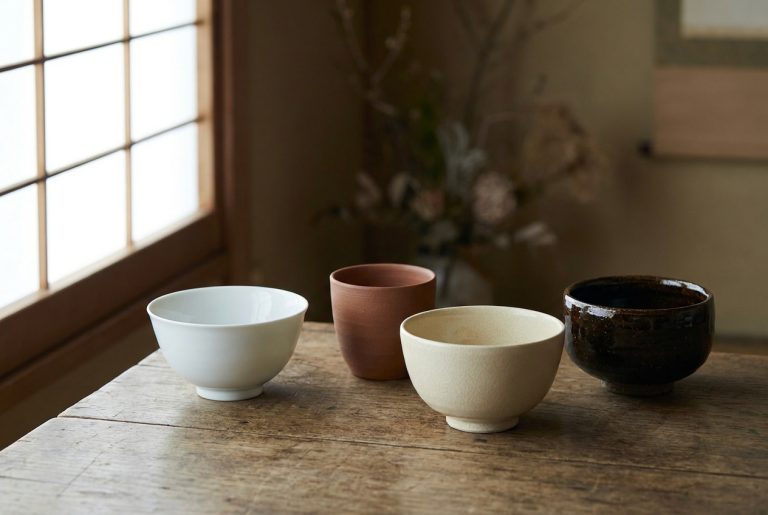
Four words cover almost everything, and they predict how a piece behaves — whether it absorbs water, whether it needs seasoning, whether it rings or thuds.
- 磁器 — Porcelain
- Vitrified, near-zero water absorption, often faintly translucent, rings when tapped. Doesn’t stain, doesn’t need seasoning. Cool and smooth.
- 半磁器 — Semi-porcelain
- Between porcelain and earthenware. Denser than earthenware, less translucent than porcelain. A common, affordable middle ground.
- 炻器 — Stoneware
- High-fired and dense, but usually with a visible clay body. Low absorption, hard-wearing. Bizen and Shigaraki live here.
- 陶器 — Earthenware
- Lower-fired and porous. Benefits from medome (seasoning in rice-water) before first use; can stain and craze. Warm, slightly rough.
You’ll also see two pieces of trade shorthand: 土物 (tsuchimono), “clay things” — the porous, tactile earthenware/stoneware feel — and 石物 (ishimono), “stone things” — the hard, cool porcelain feel. Sellers use them to set your expectations before you touch the piece.
Reading the surface: hand-painted vs. transfer-printed
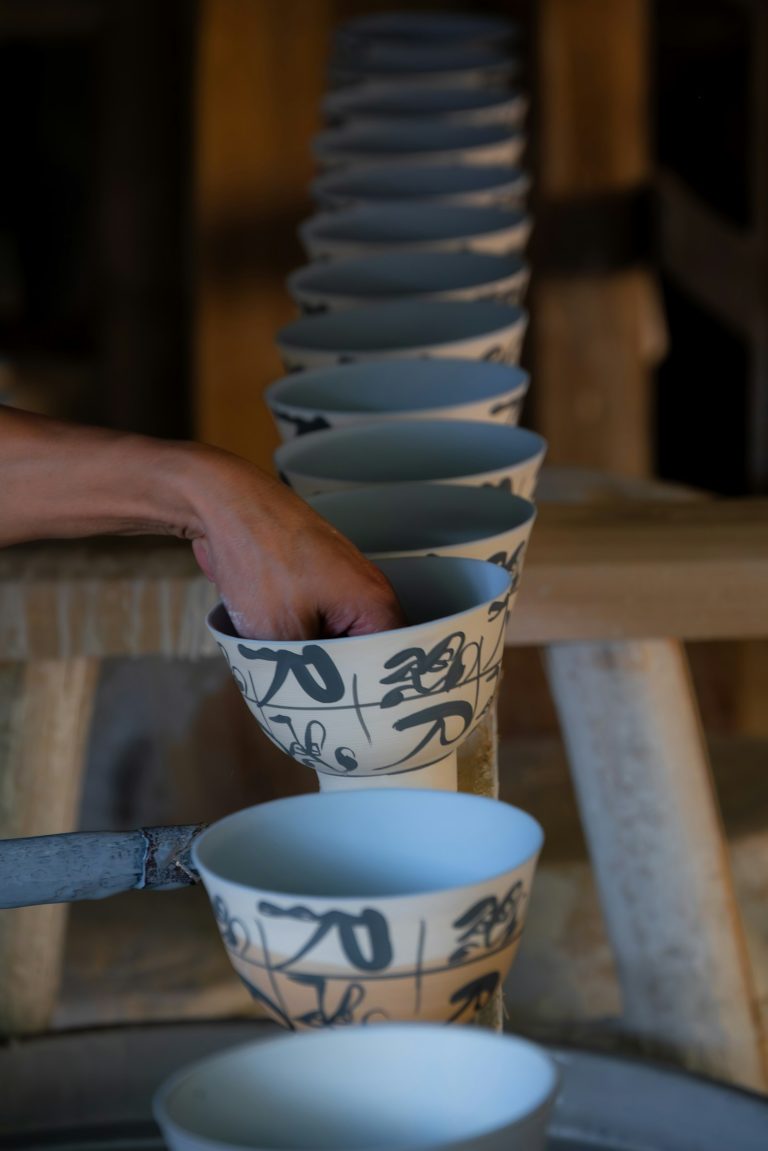
The single biggest price driver you can check from a photo is whether the pattern was hand-painted or transfer-printed. The problem isn’t transfer printing — it’s paying hand-painted money for it. Three tells, all visible in a listing photo of serving plates or a matched set:
| Look for | Hand-painted | Transfer / print (印判) |
|---|---|---|
| Line width | Varies — thick to thin within one stroke | Uniform along its whole length |
| Surface / light | Overglaze sits raised; catches light on one side | Flat, flush with the glaze |
| Across a set | Motif shifts slightly piece to piece | Identical position on every piece = transfer |
“-yaki” is a place, not a style
Arita-yaki, Hasami-yaki, Mino-yaki — the “-yaki” (焼) names a place of origin, protected as a regional collective trademark. It is not a style or a quality grade. This matters commercially: Hasami ware was shipped and sold as Arita for years, and only separated out after origin-labelling rules tightened in the 2000s. Same potting tradition, often lower price — because you are no longer paying for the more famous place name. Mino, quietly, makes roughly half of all Japanese tableware. The same everyday pieces show up in our guides to chopsticks and hashioki and across the table.
What the listing doesn’t tell you
Ceramic tableware in Japan has no legally required labelling fields — unlike lacquerware or tempered glass, which are covered by household-goods labelling law. So a blank isn’t an oversight; it’s a choice. Read the silences:
- No microwave note = not permission and not prohibition — it is untested. Assume nothing.
- No photo of the foot (kodai) = you can’t judge the finish where quality shows most.
- No weight given = you can’t tell delicate from clumsy.
- “Handmade” but no note on variation = a quiet contradiction worth a question.
Reuse & citation
The diagrams and tables on this page are released under CC BY 4.0. You’re welcome to reproduce them in articles, guides, or teaching material — commercial or not — as long as you credit Nagori Ware with a link back to this page.
Suggested credit: Diagram: Nagori Ware — nagoriware.com/japanese-tableware-sizes-terms
Writers & editors: happy to provide higher-resolution versions or a specific figure on request.
Disclosure: Nagori Ware is an independent editorial guide written from Japan. Some links elsewhere on the site are affiliate links; this reference page is not sponsored. Parts of this site are drafted with AI assistance and checked against Japanese sources. Figures reflect common trade practice and traditional units — always confirm exact dimensions with the individual maker or seller. General information, not legal or safety advice.