What Otoshibuta Size to Buy — and Why a Japanese Drop Lid Must Never Fit Your Pot
In a kitchen shop in Tokyo you can pick up two wooden drop lids, both with 18 printed on the label, and find that one of them is fifteen centimetres across and the other is eighteen. Neither is mislabelled. They are answering two different questions, and the shop assumes you know which one you are being asked.
That confusion is worth clearing up, because underneath it is the thing nobody explains: an otoshibuta — a Japanese drop lid — does not work by covering the pot. It works by not covering it. The two or three centimetres of broth you can see all the way around the disc is not slack. It is the mechanism. Get that number wrong in either direction and you have bought a coaster.
A way of stirring a pot you must never stir
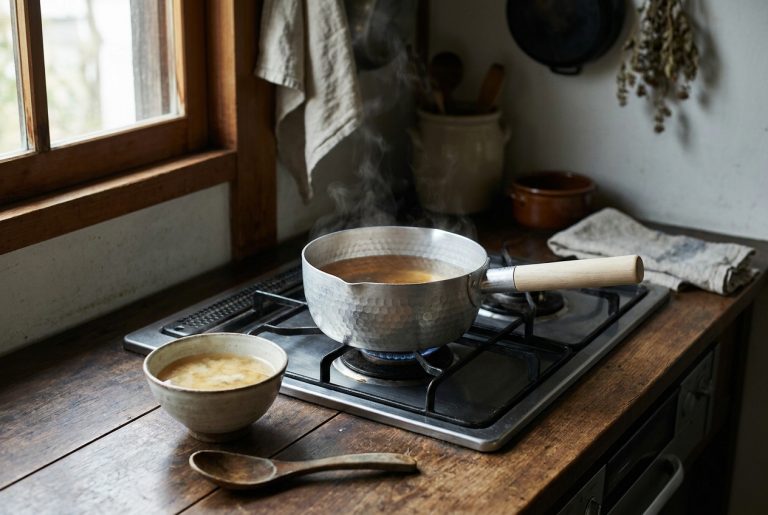
Start with the problem the tool was invented for. Japanese simmered dishes — nimono — are cooked in shallow, strongly flavoured broth, often with the liquid coming only two thirds of the way up the food. Simmered daikon, taro, kabocha, braised fish. All of it is soft by the time it is seasoned, and all of it will collapse if you push it around. Japanese has a word for that collapse, nikuzure, and avoiding it is half the craft.
So you cannot stir. You also cannot leave it alone, because the top third of every piece is sitting in steam rather than broth and will come out pale and underseasoned. A Western braise solves this by drowning the food or by turning it. Japanese cooking solves it with a disc of wood.
The Japanese descriptions are consistent about what happens. Boiling broth strikes the underside of the lid, and the collision sets up a circulation — tairyu — that carries seasoning evenly through a small volume of liquid. Japanese Wikipedia’s entry puts the benefit plainly: the boiling broth hits the lid, so even a small amount of liquid seasons the food without unevenness. Ninben, the Tokyo katsuobushi house, lists the same circulation as the third of five effects, alongside slower evaporation, less collapse, and — usefully — the fact that lifting the lid off skims the scum with it.
Even the English retail copy gets this right when it is written by someone who cooks. Milk Street describes its adjustable steel version as something that “forces liquid to circulate (so food is evenly covered with no stirring required)” and “weighs those items down just enough to keep them below the surface.” That is the whole tool in one sentence: it is a substitute for the spoon.
What the gap does
Here is where the sizing comes from. If the broth is going to hit the lid and come back down over the food, it needs a route up and a route back. That route is the ring of gap around the edge.
The Japanese sources name one job of that ring outright. Ninben notes that steam — and with it any off smell from the fish or the vegetables — escapes through the space between the pot and the drop lid; Japanese Wikipedia makes the same point about not trapping odours. So the gap is documented as a vent. That the same gap is also the return path for the circulation is my reading rather than something a maker prints, but it is the reading that makes every maker’s sizing chart agree with every other one, and no other reading does.
Follow it and the failures become predictable. A lid that fits the pot has no ring: the broth has nowhere to climb, so nothing washes back down, and you have simply moved an ordinary lid a few centimetres lower. A lid much too small covers the middle and leaves the outer pieces standing in steam — the exact problem you bought it to fix. In between, it works.
Two numbers, one word: what otoshibuta size actually means
Now back to the two lids marked 18. Japanese makers use two different conventions and neither flags which one it is using.
Umezawa Mokuzai Kogeisha, the Kiso woodworker whose sushi tubs turn up in our guide to sushi rice tub, sells a Kiso sawara drop lid listed as 20 cm. That is the disc: about 200 mm across, 11 mm thick, ¥1,144 including tax, with a 33 mm handle. The page then tells you what to do with the number — “choose a size 2 to 3 cm smaller than the diameter of your pot.”
Kiya, the Nihonbashi cutler, also prints the disc, in millimetres, and publishes the pairing: 140 mm for a 150 mm pot, 160 mm for a 180 mm pot, 180 mm for a 210 mm pot. The lids are laminated Kiso sawara pinned with bamboo nails, and run roughly ¥1,700–¥2,000 at retail.
ambai, the housewares line designed by Makoto Koizumi, prints the pot. Its “16 cm” lid is a 130 mm disc; “18 cm” is 150 mm; “20 cm” is 170 mm. Same Kiso sawara, unfinished, ¥1,430–¥1,650, 30 mm tall overall including the handle. Buy an ambai “18 cm” thinking it is a disc and then subtract your two or three centimetres, and you will be cooking with something five centimetres too small.
Convert all of them to a ratio and the disagreement mostly evaporates. Kiya runs 93%, 89%, 86%. ambai runs 81%, 83%, 85%. Umezawa’s rule of thumb lands between 87% and 91% for the pots people actually own. So the working number is about 87% of your pot’s inside diameter, and anything from 81% to 93% is inside what Japanese makers themselves ship.
One more thing falls out of the table, and I have not seen it said anywhere: the gap is not a constant. Kiya leaves 10 mm on a small pot and 30 mm on a large one. “Minus two to three centimetres” is a shorthand that is roughly right for a 20 cm pan and too generous for a 15 cm one. Multiply instead of subtracting.
Measure your own pot across the inside of the rim before you multiply. Japanese cookware is sized by its mouth, but the number on a box has a way of meaning whatever the seller found convenient — the same habit that runs through how a Japanese listing is written, where the silences on a product page tell you as much as the specifications do.
Buy this, not that
If you own one pot you cook nimono in, buy one wooden lid at about 0.87 × the inside diameter of that pot — roughly ¥1,100–¥2,000 in Japan, about $10–$22 abroad. That is the whole purchase.
If you own four pots, do not buy four lids. Buy the adjustable stainless one (Milk Street’s is $25.95 and spans 5.5–9 inches, about 14–23 cm) or cut parchment for free. And whatever the photo shows, do not buy a lid that matches your pot: a disc that fits is a disc that does nothing.
Wood, steel, silicone, paper
The materials are not interchangeable, and the differences are about weight rather than looks.
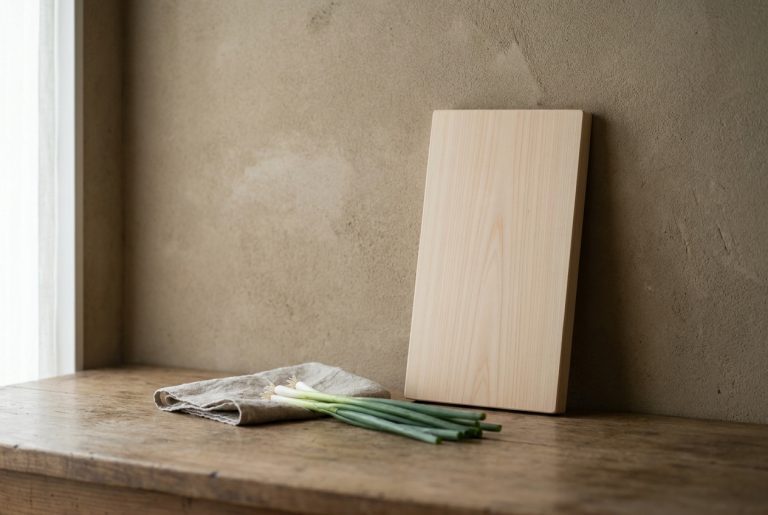
Wood is the default because the weight is the point: it holds the food down without crushing it, and Japanese Wikipedia notes it is the heaviest of the common options. Almost every good one is sawara, Japanese cypress from Kiso — the same timber used for rice tubs, rice paddle, and sushi tubs, chosen because it tolerates constant wetting, takes on water at a moderate rate, and smells far less than hinoki. In a lid that spends its life lying in dashi, low odour is a specification, not a nicety. The wood also insulates, so the handle stays cool enough to lift bare-handed over a boiling pot.
Stainless steel takes no smell at all and survives a dishwasher, and the adjustable versions solve the real problem of a household with four pot sizes. The trade is weight: steel is light, and Milk Street’s own copy is careful to say it weighs food down “just enough.” For firm root vegetables that is fine. For something that wants pinning, wood does more.
Silicone is pleasant to store and, per Ninben, prone to picking up colour from whatever it has been sitting in. Paper — parchment, kitchen paper, washi, or the thin cedar sheet called kyogi — is not the poor relation. Japanese Wikipedia and the trade both recommend it specifically for delicate ingredients, because a heavy wooden lid on tofu or soft-simmered fish makes the collapse worse rather than better. To make one, fold a square of parchment into quarters, then into a triangle, trim it to a radius a little under your pot’s and snip the tip and a few slits along the fold; kitchen paper needs no holes at all, since air passes straight through it.
Aluminium foil works and costs nothing — crumple it, smooth it back out so it drapes, and pierce a few holes with a chopstick. Ninben adds a caution I will pass on without ruling on it: do not leave foil sitting on an acidic or alkaline dish for a long simmer. I use parchment for anything with vinegar or tomato in it because it costs nothing to.
First use, and the water that goes brown
Every Japanese maker gives the same instruction and no English product page I could find gives it at all: wet the lid before you put it in the pot. Umezawa says to soak the whole thing; ambai says to dip it once under running water. The reason is mechanical rather than ceremonial. Dry sawara drinks the broth, and what it drinks it keeps — the smell of last week’s fish, the colour of last week’s soy. Wet wood is already full and takes on almost nothing.
Two things will surprise you the first few times. New sawara smells of sawara, faintly and pleasantly, and ambai says that fades with use. And a laminated lid can weep a little sticky resin, kiyani; ambai describes it as a natural resin that is water- and acid-resistant and states that it is harmless — that is the maker’s wording, and I will leave it where they put it. Practically, it wipes off.
Afterwards: wash it promptly with a brush and water rather than letting it stand, then dry it completely before it goes back in a cupboard — hanging it is easiest. Kiya says plainly that its lids are not for the dishwasher or a drying cabinet, which is the same rule that governs unfinished wood everywhere on the Japanese table, from bento box to a plain wooden sushi rice tub. Coated wood behaves differently again, and that difference is the whole subject of our guide to lacquerware. If you want the general principles for what survives a machine, they are in the microwave and dishwasher guide; this article makes no judgement of its own about dishwashers.
Buy this, not that
Do not buy a wooden drop lid if it is going to live damp in a closed cupboard, if most of what you braise is acidic, or if you already own five pots in five sizes. In all three cases parchment is not a compromise — it is the better tool, and a roll of it costs less than one lid.
Do buy wood if you cook the same one or two pots of nimono every week. An 11 mm sawara disc is the cheapest thing in a Japanese kitchen that changes how a dish comes out.
Where it sits in the kitchen
A drop lid belongs to the same small family of Japanese tools that do one mechanical job extremely well and look like nothing: the suribachi, whose ridges do the grinding the pestle gets credit for; the grater, where the irregular teeth matter more than the metal; the rice paddle, which is a texture instrument rather than a scoop. In each case the object is plainer than the idea inside it.
What comes out of the pot then goes somewhere. Simmered vegetables are served in the small deep bowls covered in our guide to small dishes, and if you simmer in a donabe rather than a metal pan, a wooden lid is the natural partner — though the seasoning and heat rules for clay are their own subject there. General washing and drying habits for everything else on the table are in the care guide, and the wider layout of a Japanese meal is in our guide to the Japanese table. If you would rather just look numbers up, the sizes and terms reference has the conversions on one page.
The number nobody prints
Every listing gives you a diameter, in one of two conventions, with no note saying which. None of them gives you the measurement that decides whether the thing works, which is the width of the ring of broth left showing around the edge — ten millimetres in a small pan, thirty in a big one, on the authority of the people who have been making these since before the shops that sell them existed.
So do the arithmetic yourself. Measure inside the rim, multiply by 0.87, round to the nearest size the maker offers, and check whether the number on the box is describing the pot or the lid before you press buy. It is a two-thousand-yen purchase with an unusually high chance of being wrong for a reason nobody warns you about.
Disclosure: Nagori Ware is an independent editorial guide written from Japan. Some links elsewhere on the site are affiliate links. Parts of this site are drafted with AI assistance and checked against Japanese sources. General information, not legal or safety advice. Prices are what Japanese and US sellers showed in August 2026 and move. Where this article mentions what a maker says about foil, resin or dishwashers, it is reporting that maker’s wording, not making a food-safety judgement of its own — follow the instructions that came with your own lid.