Makisu: Which Side Goes Up, and What Size Sushi Mat to Buy
Buy the 27 cm square. Not because it is better made — at this price nothing is better made — but because a sheet of nori is 21 cm wide and 19 cm deep, and a 24 cm mat leaves you five centimetres of bamboo to finish the roll with. That is the whole size question. It has one input.
The other question people actually ask — which side goes up — has a better answer than the internet gives it, and the reason the internet disagrees with itself is interesting: there are two different mats being sold under one name, and only one of them has a correct side.
A makisu (巻きす) costs between two and eight dollars. It is the least consequential purchase in Japanese cooking and one of the few where the cheap one is genuinely fine. So this guide is short on shopping and long on the two things that will actually change what comes out.
What size makisu to buy: the nori decides, not the meal
Japanese nori has been sold in one standard sheet since the Shōwa 40s — the decade beginning in 1965. Before that, sizes varied by producing region. The standard sheet, called zenkei (全形), is 21 cm tall by 19 cm wide, and every sushi recipe written in Japan assumes it. The Ministry of Agriculture, Forestry and Fisheries states the same figure in its consumer Q&A.
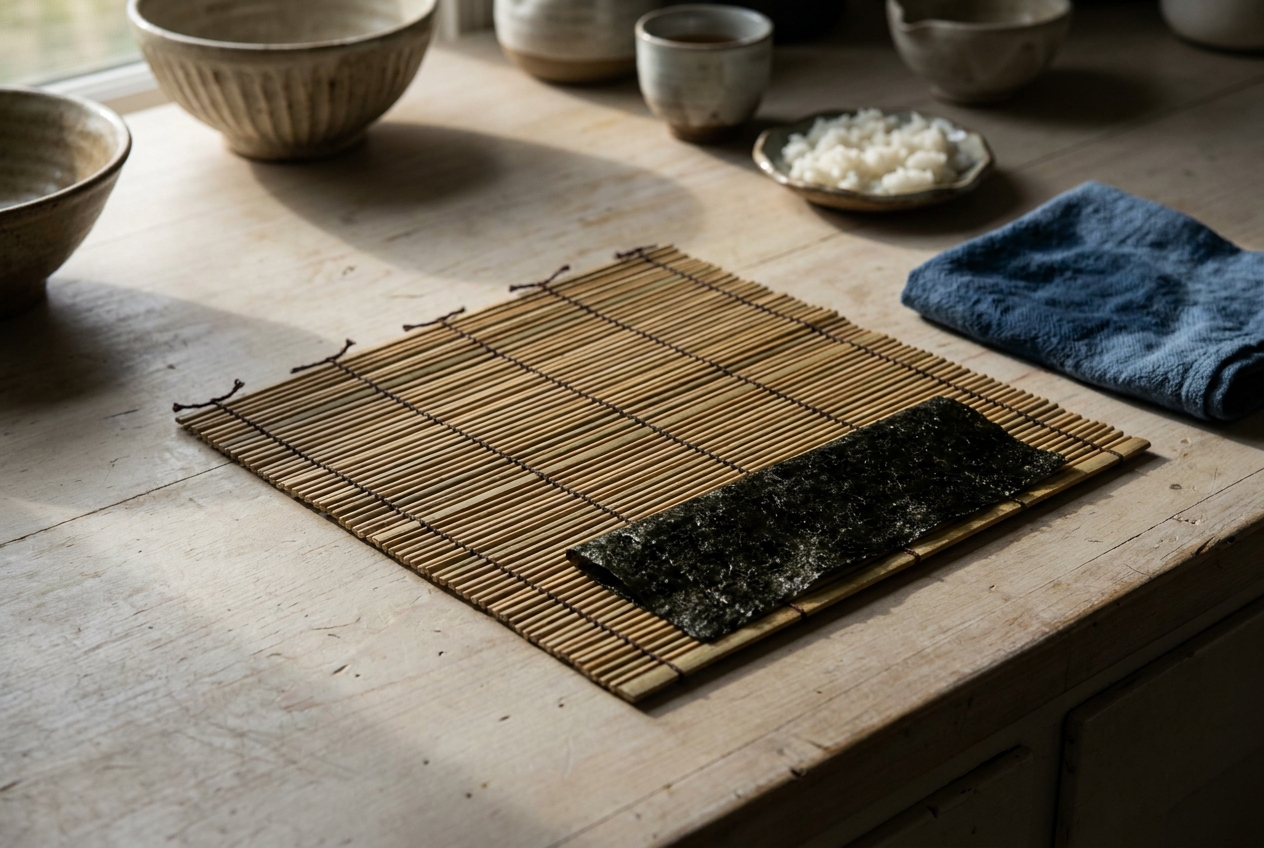
When you roll, that sheet goes on the near edge of the mat with the long side (21 cm) running left to right and the rough face up. You roll away from yourself. So the mat has to be wider than 21 cm across, and deeper than 19 cm from front to back — and whatever is left over at the back is the only bamboo you have to hold, lift and tighten with.
Run the arithmetic on the three sizes that Japanese shops actually stock and the advice writes itself.
| Mat | Bamboo past each end of the roll | Free mat behind the nori | Honest verdict |
|---|---|---|---|
| 24 × 24 cm | 1.5 cm | 5 cm | Fine for thin rolls and half sheets. Short for a packed futomaki. |
| 27 × 27 cm | 3 cm | 8 cm | The default. One mat that does every roll a home kitchen makes. |
| 30 × 30 cm | 4.5 cm | 11 cm | Easier on fat rolls; clumsy for thin ones, and it stores badly. |
| 27 × 18 cm (hoso) | 3 cm | n/a — built for half sheets | A specialist mat for hosomaki. Buy second, if ever. |
Japanese buying guides say the same thing in fewer words: 24 cm suits thin rolls, and if you are making futomaki you want 27 cm or more. The number is not a preference. It is the sheet.
Two things the listing will not tell you. First, a mat described in inches — 9.5″, 10.5″ — is the same 24 and 27 cm mat with the label translated, so do not pay a premium for the imperial one. Second, the depth matters more than the width, because the width only has to clear the ends of the roll while the depth has to come all the way over the top of it. A thick roll five centimetres across needs roughly sixteen centimetres of mat just to travel round itself.
Buy this, not that
Buy one 27 × 27 cm bamboo mat, the cheapest one your shop sells, and spend nothing else. Do not buy the 24 cm “starter” mat that comes in sushi kits — it is the size that runs out mid-roll. Do not buy a second mat until you have made ten rolls and know whether you are a hosomaki person.
Which side of the sushi mat goes up?
Search this and you will find confident answers in both directions: the flat side goes up; there is no right side. In Japanese the same split exists — a kitchenware dealer will tell you the faces are interchangeable, and a food maker’s own explainer will tell you the skin side always faces the food. They are not contradicting each other. They are looking at different mats.
If the bamboo still has its skin on
Split bamboo has two faces: the outer skin, which is smooth, slightly waxy and does not take up water, and the cut inner face, which is dull, fibrous and thirsty. On a mat made from skin-on splits you can see the difference at arm’s length — one side has a faint sheen and sometimes a green cast, the other is pale and matte. Yamasa, writing about the tool, states the rule directly: an ordinary makisu is rolled with the skin side against the food, because that is the side that does not drink the moisture out of the rice.
This is the answer people are reaching for when they say “flat side up”. On a traditional mat the skin face is also the flatter face, so the two rules agree by accident. The skin is the reason, though, not the flatness.
If it is made of round, skinned rods
Most mats sold for a couple of dollars are cylindrical rods with the skin machined off. Both faces are the same bamboo, the same roundness, the same thirst. There is no correct side, and anyone who tells you there is, about that mat, is repeating a rule from a different object. Flip it whichever way the knots fall.
Where the string goes — the part that actually matters
Regardless of face: lay the mat with the knotted, trailing ends of the binding string on the far side, away from you. On the near edge they get caught in the first turn of the roll, and you find out after you have cut it. This is the one orientation rule with a consequence you can taste, and it is the one nobody mentions.
The oni-sudare is not a sushi mat, and it is used backwards
If you have seen a mat made of fat triangular rods rather than flat splits, that is an oni-sudare (鬼すだれ) — roughly “demon blind”. Taketora, a bamboo specialist in Kōchi, sells one at about 24 × 24 cm and 200 g, the rods shaved one by one into triangles with the skin left on, and the binding string threaded so that nothing shows on the inner face. It is ¥2,750 — more than ten times the price of a rolling mat, and it cannot roll sushi well.
It has one job: datemaki, the sweet rolled omelette that appears in New Year food. The triangular ridges are turned towards the egg so they press a run of waves into the outside of the roll. That is why this is the single mat used the opposite way round from every other — the ridged face is the working face. Buy it only if you are making osechi, which is a conversation about what size jubako to buy rather than about sushi.
What a makisu costs, and why almost none of it is quality
Korin, the professional supplier in New York, is a useful price check because it sells to restaurants and lists origin. Its plain 27 × 27 cm bamboo mat is $2.20 and made in China. Its “Tokyo” mat, same size, double-strung for durability, is $7.95 — also made in China. The one Japanese-made mat in the lineup is the 27 × 18 cm hoso mat at $7.65.
Read that the way a buyer should. The mat that professional sushi kitchens go through by the box costs two dollars, and the premium version costs eight and is from the same place. Country of origin, which is worth real money on lacquer, buys you very little here. What the extra six dollars buys is the second string — a mat tied with two strings per row rather than one holds its rectangle longer once the bamboo starts to loosen.
Hand-made makisu do still exist in Japan and have become genuinely scarce as the makers retire. They are a nice thing to own. They are not a better roll.
Why sushi chefs wrap the mat in film — and what that means for buying
Watch anyone make uramaki, the inside-out roll with the rice on the outside, and the mat will be sleeved in plastic film. The reason is mechanical: bare rice pressed against bare bamboo goes into the gaps between the slats and stays there. Film also saves the wash-up on ordinary rolls, which is why a lot of busy kitchens leave it on all shift.
For a buyer this cuts two ways, and it is worth being honest about both. If you intend to wrap the mat anyway, then the face question stops mattering entirely and the cheapest rod mat is the correct purchase — you are buying a flexible former, nothing more. If you want to roll bare, which is how futomaki and hosomaki are made at home in Japan, then the skin-on mat earns its couple of extra dollars, because the face that does not absorb water is the face that lets go of the nori.
How Japanese makers say to look after one
The care instructions that come with a bamboo mat in Japan are consistent and short. Izumiya, which sells them, describes the routine: soak for five to ten minutes in lukewarm water around 40°C, work the grooves with a soft sponge and a bamboo skewer, and wash with water alone. The reason given for skipping detergent is specific — bamboo takes up the smell and the residue, and keeps them. Then dry it properly with a cloth and finish it in a shaded, airy place rather than in the sun.
Storage matters more than washing. A mat sealed damp in a plastic bag is the classic way to ruin one; the same advice tells you to keep it somewhere that breathes. That is also why the mat is worth replacing rather than nursing: at two dollars, a mat that has gone dark in the grooves is not a restoration project.
One thing this guide deliberately does not do is rule on dishwashers or microwaves. Those questions have real answers for tableware and we keep them in one place — our guide to what is microwave and dishwasher safe — rather than scattering half-remembered versions through every article.
The other bamboo mat on the Japanese table
Confusingly, there is a second flat bamboo thing in a Japanese kitchen and it is not interchangeable. The su that sits inside a cold soba tray is a drainage rack — it is rigid, it is sized to the tray, and it is very often sold separately from the tray it belongs to. A rolling mat is flexible by design because it has to curl. Neither substitutes for the other, and sellers photograph them so similarly that buyers do end up with the wrong one.
A third, unrelated mat turns up in matcha equipment, where a small woven mat is used as a rest rather than a tool. Same material, different family.
So which one should you buy?
You are making sushi at home a few times a year
One 27 cm bamboo mat, cheapest available, plus a roll of cling film. Total outlay under five dollars. The money in home sushi is not in the mat — it is in the hangiri you cool and season the rice in, which is the piece that actually changes the rice.
You want to roll bare, the way it is done in a Japanese home
Look for a mat where the two faces are visibly different: one with a sheen, one matte. That is skin-on split bamboo, and the sheen side goes against the nori. Expect to pay a few dollars more and to look a little harder, because the cheap end of the market is all skinned rods.
You make osechi at New Year
Then the oni-sudare is a real purchase and the rolling mat will not do the job. It is also the only item here where Japanese-made is worth the difference, because the triangles have to be cut cleanly to print a clean wave.
You are buying a gift for someone who likes Japanese food
Not this. A makisu is a two-dollar consumable and it reads as one. Give them a sushi plate or a set of small dishes instead — things that stay on the table rather than in a drawer.
The useful idea here is that the makisu is one of the very few Japanese kitchen tools with no craft premium worth paying. Almost everything else on this site rewards spending a little more — better clay, real lacquer, a size that was chosen rather than rounded. The rolling mat rewards spending less and knowing two numbers: 21 by 19, and which face still has its skin.
Related guides
- What size hangiri (sushi oke) to buy — the tub that cools and seasons the rice, and the only real spend in home sushi
- Japanese sushi plates and serveware — what to serve the finished rolls on
- Zaru and seiro soba trays — the other bamboo mat, and why it is sold separately
- Japanese tableware sizes and terms — sun, gō and the rest of the unit key behind Japanese sizes
- How to read a Japanese tableware listing — how to read the silences in a Japanese product page
- Seasonal Japanese table setting — where ehomaki sits in the Japanese year
- Japanese tableware and dinnerware — the pillar guide to building a Japanese table from nothing
Disclosure: Nagori Ware is an independent editorial guide written from Japan. Some links elsewhere on the site are affiliate links. Parts of this site are drafted with AI assistance and checked against Japanese sources. General information, not legal or safety advice.