What Size Yukihira Nabe to Buy — and Whether Those Hammer Marks Were Ever Hammered
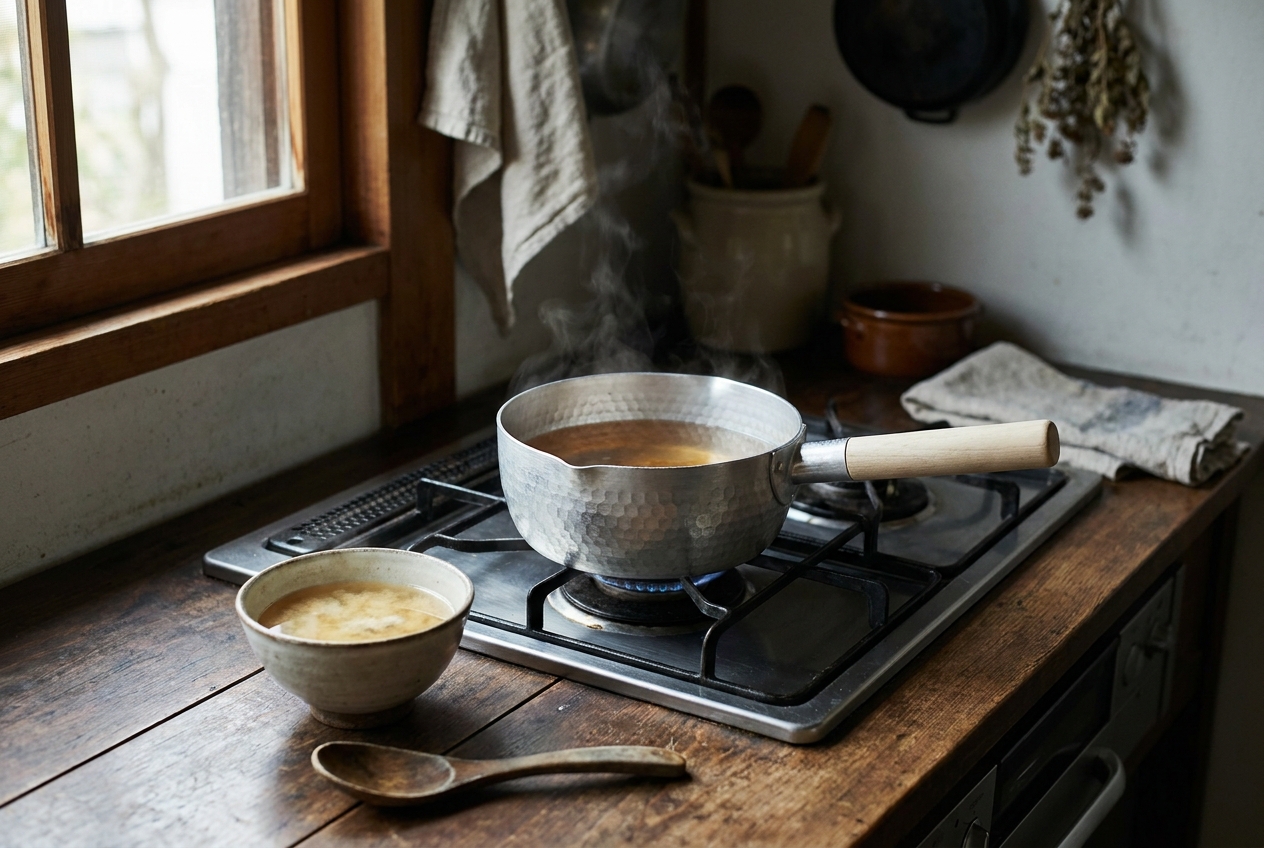
A yukihira nabe is the small, dimpled, one-handled pan that is in every Japanese kitchen and almost every Japanese restaurant. Buying one looks like a choice between sizes. It is really a choice between three things, in this order: whether your cooktop can heat the classic version at all, whether the dimples on the pan you are looking at were hammered or merely stamped, and only then whether you want 15, 18 or 21 cm.
The short version. If you cook on induction, the traditional aluminium pan is off the table — it will not heat, and no amount of craft changes that. If you cook on gas, buy 18 cm, buy one that says uchidashi (打出, struck), and check that the listing tells you the wall thickness in millimetres. That is the whole decision, and the rest of this guide is why.
Before size: can your cooktop even heat it?
This is the part that gets skipped in English write-ups, and it is the part that decides whether the pan is usable in your kitchen. A classic hammered aluminium yukihira is sold for gas. The reference maker’s catalogue lists it, plainly, as not IH-compatible. Aluminium is not magnetic, so an induction hob has nothing to grip.
Manufacturers solve this by building a different pan: aluminium with a stainless disc bonded to the base, or a three-layer wall with aluminium sandwiched between stainless. Those work on induction. There is also a second requirement people hit after buying — the base has to be wide enough for the hob to notice it at all, generally around 12 cm, which quietly rules out the smallest sizes on some cooktops.
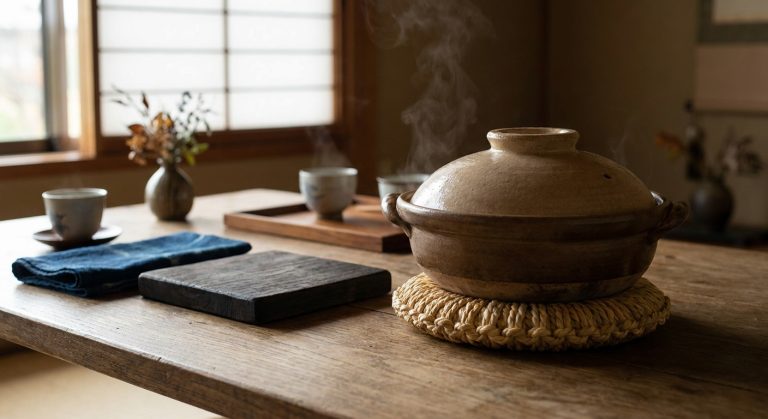
If that sounds familiar, it is the same question you have to ask of a donabe, which is also built for a flame and also needs an explicit IH rating before it will work on induction, and the same line you have to read on a cast iron kettle. Metal or clay, the listing has to say so.
What the hammer marks are actually for
Aluminium is soft. That is the problem the yukihira solves, and the dimples are the solution rather than the decoration.
The technique is tankin — metalsmithing — and on a hand-made pan the marks are the record of a craftsman striking the wall, one blow at a time. Japanese makers give two reasons for it. The first is surface area: a dimpled wall has more of it, so heat moves into the pan faster. The second is the one that matters more, and it is a property of the metal rather than the shape. Struck aluminium work-hardens. The blows change the metal itself, so a wall thin enough to weigh almost nothing stops behaving like something thin. One retailer’s way of putting it: a pan with real hammer marks is still solid forty years on.
Which sets up the uncomfortable bit.
The pattern is available without the hardness
A Japanese cookware retailer states it directly in its buying guide: on cheap pans, the pattern is sometimes stamped from a die, with no work-hardening behind it. The pan looks like the hammered one. It is not the hammered one. You are buying the photograph of a manufacturing process rather than the process.
There is a visual cue, and it is free to check. A die repeats itself exactly, so stamped dimples march in an even grid. A hand is not a die: real hammer marks overlap, vary in depth, and run slightly off-line. If every dimple in the product photo is the same dimple, you are looking at a press.
The cue is helpful but not decisive, so use the spec line instead. This is the same habit as reading a Japanese product page for its silences: the useful information is often in what a listing declines to mention. Makers who hammered the wall say so, and they publish the wall thickness. The pans in the table below are listed at 1.7 mm and 2.0 mm because the maker is willing to be held to it.
What size yukihira nabe to buy: 15, 18 or 21 cm
Japanese kitchenware is sized by the diameter of the mouth in centimetres, not by volume, and the figures below are one maker’s hand-hammered aluminium line. Capacity is given brim-full, which no one cooks at, so treat the usable volume as roughly two-thirds.
| Size | Brim-full | Wall | Empty weight | What it is for |
|---|---|---|---|---|
| 15 cm | 0.9 L | 1.7 mm | 210 g | One or two bowls of miso soup; boiling a couple of eggs; a small sauce |
| 18 cm | 1.6 L | 1.7 mm | 300 g | Three or four bowls of soup; a one-person noodle portion; everyday simmering |
| 21 cm | 2.4 L | 2.0 mm | 430 g | Blanching greens; noodles without boiling over; a family-sized simmered dish |
A bowl of miso soup in Japan is something like 150 to 200 ml, which is how the sizes translate into the advice Japanese guides actually give: 15 cm for one or two servings, 18 cm for three or four, and 21 cm once you are blanching a bunch of greens or cooking noodles that need room not to boil over. If you buy exactly one, buy 18 cm. The Japanese buying guides I checked agree on that, and none of them hedge.
Depth is worth a glance as well, because it is the number that decides whether noodles stay in the pan. At 18 cm the maker lists 6.5 cm deep; at 21 cm, 8 cm. The sizes are given in plain centimetres here rather than the traditional units used for tableware, though if you shop across both you will still want the conversion key for sun, gō and the rest.
Buy this, not that
Buy the 18 cm hammered aluminium pan if you cook on gas — roughly $40–45 in the US, 300 g, and repairable. Do not buy the aluminium pan at all if your hob is induction; it will not heat, and this is the single most common mistake with this pan. And do not pay a craft premium for a stamped pattern: if the listing will not give you a wall thickness in millimetres, it is a $15 pan wearing a $45 pan’s face.
The weight column is the point of the whole pan
300 g at 18 cm is the number to hold on to. A stainless yukihira of the same size generally runs somewhere around 400 to 500 g, and a Western tri-ply saucepan is heavier again. That difference is not a spec-sheet curiosity. It is the reason this shape exists.
A yukihira is designed to be picked up, poured from and put down with one hand, repeatedly, all service. In a professional kitchen that happens dozens of times an hour. Lightness is not a convenience feature here; it is the working requirement that dictated a soft metal, which in turn dictated hammering the wall to make the soft metal hold its shape. The whole design runs backwards from one hand.
Aluminium carries the other half of that: it moves heat at roughly 200 W/m·K, against something in the range of 15 to 25 for the stainless steels used in cookware. Water comes to the boil noticeably faster, and the pan responds when you turn the flame down — which is what you want for dashi, where the difference between a simmer and a boil changes the result.
The stainless yukihira is a different pan wearing the same face
Most yukihira sold into English-speaking markets are stainless, for the obvious reason that stainless works on induction and shrugs off acid. Those are real advantages and worth paying for if your kitchen needs them. One Japan-made 18-0 stainless model sells for around $54, states 1.6 litres, and is explicitly rated for gas, halogen, electric, radiant and induction. If you have an induction hob, that is the pan you can actually use, and the recommendation is straightforward.
What is worth handling carefully is the marketing. The same listing describes a “signature hammered stainless steel surface” that “conducts heat efficiently.” The hammering argument, in every Japanese source I could find, is an argument about aluminium: a soft metal that work-hardens when struck, and a metal that already conducts heat about ten times better than stainless. Dimpling the outside of a stainless pan does add some surface area. It cannot make up the difference in the metal itself, and stainless does not need work-hardening the way soft aluminium does.
The same listing also says the hammered finish “hides minor dings well.” That one is checkable, honest, and probably the best reason to like the look on a stainless pan. Buy the stainless pan for induction compatibility, acid tolerance and the fact that you can scrub it — not because the dimples are doing metallurgy.
| Hammered aluminium | Stainless | |
|---|---|---|
| Induction | No | Yes, if the model says so |
| Weight at 18 cm | About 300 g | Roughly 400–500 g |
| Heat conduction | About 200 W/m·K | About 15–25 W/m·K |
| Tomato, vinegar, konnyaku | Move the food out promptly | Tolerates them |
| What the dimples do | Work-harden the wall; add surface area | Mostly hide dings |
| Typical US price, 18 cm | About $43 | About $54 |
Why there is a spout on both sides
Look at the rim and you will usually find two pouring lips, one at each side of the handle. This is not a styling flourish and it is not about pouring twice as fast. It is so the pan pours cleanly whichever hand is holding it.
It is a small thing that is quietly remarkable, because Japanese kitchen and tea tools are otherwise notoriously one-handed. Anyone who has tried to buy a kyusu designed for the left hand knows how that usually goes: the pot costs the same, and finding one is the entire problem. The yukihira is the piece that never asks the question. Some cheaper pans have a single spout — worth checking, and worth caring about if you are left-handed.
What an aluminium yukihira is bad at
This is the pan’s honest weakness, and Japanese sources are direct about it. Aluminium reacts with acid and alkali. Tomato, vinegar and the lye in konnyaku will discolour the surface, and the standard instruction is not to leave the food sitting in the pan — cook in it, then move the contents into something else. That single habit is most of the care this pan needs.
Then there is the darkening that shows up over time even with plain water. Tokyo Gas describes the mechanism: the surface oxide film is disturbed, aluminium reacts with water to form aluminium hydroxide, and that reacts in turn with minerals in the water supply until the inside of the pan goes grey-black. Their recommended fix is mechanical — a damp steel-wool pad with a little neutral dish soap, rubbed in small circles.
What I am not going to do here is tell you what that discolouration means for your health, because that is outside what I can verify and check for you, and Japanese sources do offer opinions on it that I would only be passing along. I will also not rule on dishwashers for this pan: the manufacturer’s own instruction is the one to follow, and the general principles are in our guide to what is microwave and dishwasher safe. If your pan came with a sheet, that sheet outranks this page.
The part that justifies the price: it is meant to be repaired
A $43 aluminium pan sounds expensive next to a supermarket saucepan until you notice what is sold alongside it. The New York retailer that lists the 7-inch aluminium yukihira also lists a spare wooden handle as a separate part. Japanese guides go further: wooden handles are stocked as replacement components, and long-established makers will take back a pan with a worn or dented base and hammer it straight again.
That is a different ownership model from most cookware, and it is the same logic that runs through the wooden pieces on this site — an ohitsu and a wooden shamoji are also built on the assumption that you keep the object and maintain it rather than replace it. The pan is not priced as a pan. It is priced as a pan with a service life.
The wooden handle has one practical consequence worth stating: it is wood next to a gas flame. Keep the flame under the base rather than licking up the side, which is good practice anyway and is the habit that keeps the handle from charring.
Where it sits among the other Japanese pans
The yukihira is the everyday one, and it is easiest to place by what it is not.
- A donabe is the opposite pan in every respect: clay, heavy, slow to heat, and valuable precisely because it holds heat rather than responding to the flame. You want that for a one-pot dish at the table. You do not want it for a bowl of soup on a Tuesday.
- A seiro is a stack that has to be matched to the diameter of the pot underneath it, which is a measurement job rather than a pan you can substitute your way out of — the sizing is worked through separately.
- An otoshibuta goes inside this pan rather than on top of it. The drop lid is sized deliberately smaller than the pot, and an 18 cm yukihira is the pot most Japanese home simmering recipes assume.
- Noodles are the edge of what this pan does. At 21 cm a yukihira manages a portion or two, but cold soba in quantity wants a taller pot and more water than this shape holds.
If you are equipping a Japanese kitchen from nothing, the yukihira belongs in the first three purchases alongside a suribachi and an oroshigane — the grinding bowl and the grater being the other two tools that Japanese home cooking simply assumes you own.
Why it has two names
You will see both 雪平 (yukihira, “snow-flat”) and 行平 (yukihira, a surname) on Japanese listings, for the same pan. Two explanations circulate, and Japanese writers tend to offer both rather than pick one. The first traces the pan to Ariwara no Yukihira, a Heian-period poet, and the vessels used to boil seawater for salt in a story attached to him. The second is descriptive: that rice dances like snow when you cook rice porridge in it, or simply that the hammer marks look like snow.
I cannot tell you which is right, and the Japanese sources that discuss it do not settle it either. It is worth knowing only because the two spellings are used interchangeably by sellers, and a search for one will miss stock listed under the other.
So which one should you buy?
You cook on gas and want the real thing
18 cm, hammered aluminium, from a maker who publishes the wall thickness. Around $43 in the US. Cook in it, pour out of it, do not store food in it, and expect to own it for a very long time.
You cook on induction
A stainless or clad model explicitly rated for induction — around $54 for a Japanese-made 18-0 stainless one at 1.6 litres. It is heavier and slower than the aluminium pan and that is the trade you are making. Do not buy the aluminium one hoping an induction disc will save it; buy the pan that fits the kitchen you have.
You already own a Western saucepan and wonder if this is different
It is, in one specific way: weight and response. If what you cook is miso soup, dashi, blanched greens and small simmered dishes — the food that Japanese meals are built around — the yukihira is genuinely better at it. If you mostly make pasta and stock, your existing pan is fine and this is a want, not a need. I would rather say that plainly than sell you a second saucepan.
You are buying it as a gift
Only if you know their hob. A beautiful aluminium pan that cannot be heated is a sad object, and it is not returnable once it has been unwrapped in another country. If you are not certain, give something that works on any table — a piece from the gift guide carries no such risk.
The thing I would want a friend to take away is that the dimples are an argument, not a decoration, and the argument only holds for one metal. On a hammered aluminium pan they are the visible record of the wall being made hard enough to survive being thin, which is what lets an 18 cm pan weigh 300 g and still be a serious tool. On a stamped pan they are a picture of that. On a stainless pan they are a finish that hides dings, which is a perfectly good thing for them to be, as long as nobody charges you for metallurgy that is not happening.
Check the hob first. Then look for a thickness in millimetres. Then buy 18 cm.
Related guides
- The Japanese donabe (clay pot) — the clay pot that does the opposite job, and the other piece that needs an explicit IH rating
- What otoshibuta size to buy — the drop lid that goes inside this pan, and why it must not fit
- What size seiro to buy — measuring the pot rather than the people, for the steamer that sits on one
- How to read a Japanese tableware listing — how to read a Japanese product page for what it does not say
- Japanese tableware sizes and terms — sun, gō and the unit key behind Japanese sizes
- Left-handed kyusu — the one other piece on this site where handedness decides what you can buy
- Japanese tableware and dinnerware — the pillar guide to building a Japanese table from nothing
Disclosure: Nagori Ware is an independent editorial guide written from Japan. Some links elsewhere on the site are affiliate links. Parts of this site are drafted with AI assistance and checked against Japanese sources. General information, not legal or safety advice.