The Natto Bowl: Why a Grooved Bowl With a Spout Beats Stirring in the Tub
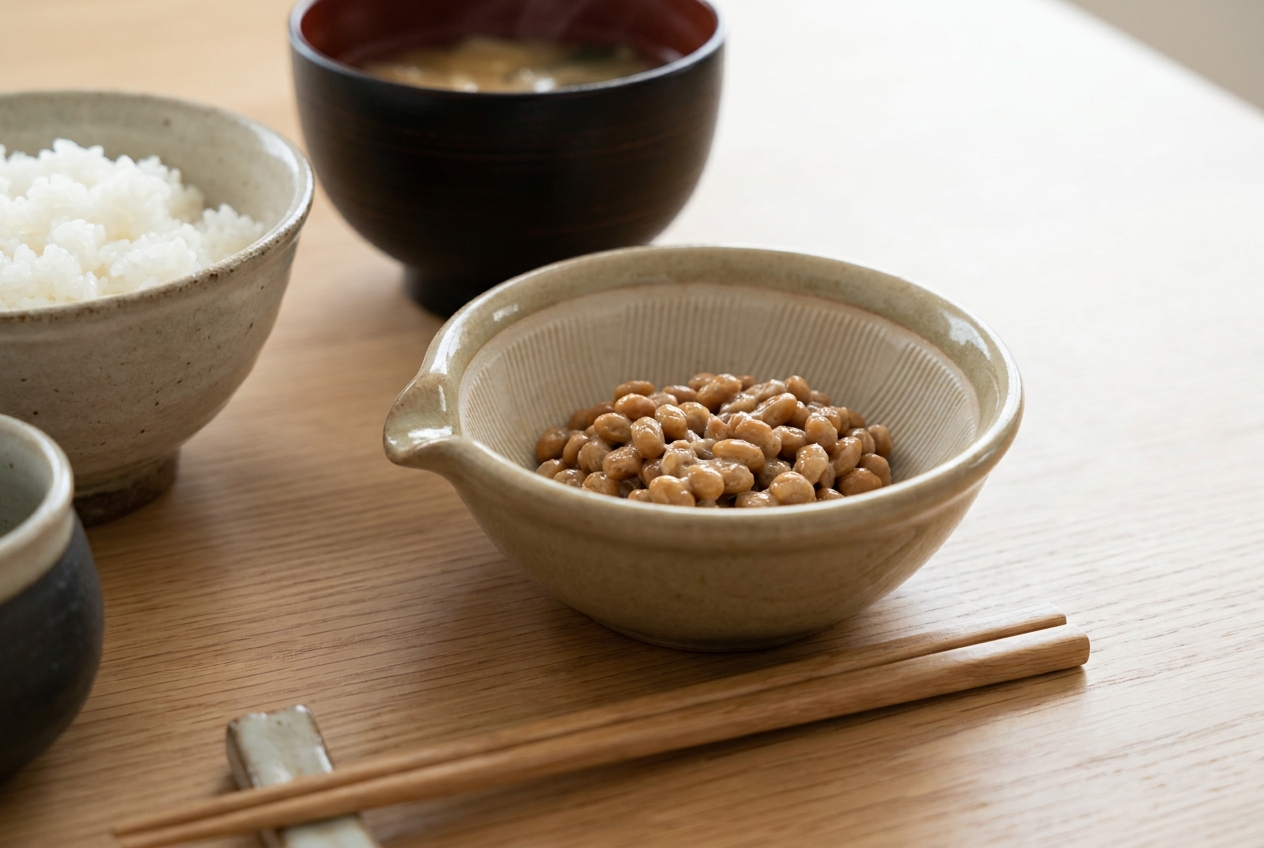
A natto bowl is a mixing tool, not a serving dish. Buy one with fine grooves inside, something to brace against while you stir (a handle or a thumb rest), and a lip or spout that can reach into an ordinary 11–12 cm rice bowl. If a bowl has all three, it does the job. If it is missing the grooves, it is just a small bowl, and the plastic tub your natto came in will do the same work for free.
That last point is not a joke. In Japan most people never move their natto out of the tub. A writer for the Japanese lifestyle site All About ran an informal poll of her followers before testing a natto bowl: about 80% stirred in the container, 18% moved it to another dish, and none of the respondents used a dedicated natto bowl. So this page is less “every Japanese kitchen has one” and more “here is the small tool that people who stir natto every morning end up buying, and why”.
What the grooves actually do
Natto is stirred until the sticky threads turn pale and foamy. The point is texture: the more air you work in, the softer and lighter the strings become. A smooth bowl lets the beans slide around as one lump. Fine ridges on the inside wall catch the strings, stretch them, and fold air in on every turn of the chopsticks.
Sellers describe the same two jobs. A Mino ware natto bowl sold by Bernal Cutlery in San Francisco says its grooves “add air” for a fluffier texture and also stop the beans clinging to the walls when you wash it. The Natto Bee bowl covered by the design site Core77 makes the same claim in reverse order: the mixture does not settle into the grooves, so it pours out cleanly onto rice and the bowl is easier to clean than a smooth one.
How much difference does it make? The same All About writer stirred natto 10, 30 and 50 times in a grooved bowl and in the tub, and photographed both. By 50 turns, the bowl’s natto had the even, fully foamed look she associated with 300–400 turns in the tub. That is one person’s side-by-side, not a lab result, so read it as “noticeably faster”, not as a ratio. It does match what the shape would predict.
Why a suribachi is not a natto bowl
If you already own a suribachi, the inside will look familiar, and it is tempting to think you have a natto bowl already. You don’t, quite. A suribachi’s pattern is kushi-no-me (櫛目), comb teeth cut into the wet clay before firing. Those ridges are a cutting edge. Their whole purpose is to break sesame seeds open against the wall. Stir natto hard in a suribachi and you will split some of the beans and pack the rest into the grooves, which is the opposite of what you want on a weekday morning with a sink full of other dishes.
A natto bowl’s grooves are shallower and softer, more like ribs than teeth. The beans are meant to roll over them while the strings get pulled. You can see the difference when you run a fingernail across each wall: a suribachi catches the nail, a natto bowl only bumps it. If the product photo shows sharp, deep radial lines all the way to the rim, that bowl was designed to grind.
The three things to check before you buy
1. Grooves on the inside wall, not only the floor. The strings form against the wall as you stir in a circle. A bowl with a textured base and smooth sides does very little. Look for ridges that start near the bottom and run most of the way up.
2. Something to hold against. Natto fights back. Fifty fast turns with chopsticks will drag a light bowl across the counter. Japanese buying guides recommend a handle for this reason, and the Bernal Cutlery listing says its handle is there for vigorous mixing. A thumb notch or a heavy, wide foot does the same job. A light porcelain bowl with neither will spin.
3. A lip that reaches your rice. Mixed natto goes onto hot rice. A standard Japanese rice bowl is about 11–12 cm across the rim (our rice bowl guide has the sizes), and once it is half full of rice there is not much target. A small spout or a pinched lip lets you tip the whole lot in one movement and scrape the rest down with a chopstick. A round rim without a lip works, but you will be pushing the last third out with chopsticks, and a few strings always land on the table.
Buy this, not that
If you eat natto three or more mornings a week, buy a grooved bowl with a handle or thumb rest and a pouring lip, sized for two packs (roughly 90–100 g). Don’t buy one if you eat natto once a month: stir in the tub and save the shelf space. And don’t use your suribachi instead. Its ridges are made to grind, and you will spend longer cleaning it than you saved stirring.
What size, in packs rather than millilitres
Natto bowls rarely list a capacity, so think in packs. A single supermarket pack of Mizkan natto is about 45 g, and some varieties sit at about 50 g. A three-pack comes to roughly 130–140 g. Then you add the sauce and mustard sachets, and many people add more: a raw egg yolk, chopped green onion, a spoon of kimchi or grated daikon.
That is why the sensible size is “two packs”. One Japanese reviewer of a popular natto bowl said it holds about two commercial packs, and that one pack plus extras left plenty of room. Room is the point. You need clearance above the beans so the strings don’t climb over the rim while you stir fast. The white Mino bowl from Bernal Cutlery is listed at 170 × 120 × 100 mm, and the 170 mm includes the handle, so the bowl itself is smaller than it sounds. Treat anything around that footprint as a one-to-two-person bowl.
| What you stir | Rough weight before extras | Bowl to look for |
|---|---|---|
| 1 pack, soy sauce only | about 45–50 g | The tub is fine; any grooved bowl works |
| 1 pack + egg, onion, kimchi | about 100 g with the extras | A two-pack natto bowl |
| 2 packs for two people | about 90–100 g | A two-pack natto bowl, deep rather than wide |
| A whole 3-pack | about 130–140 g | A larger bowl, or stir in two batches |
Deep beats wide. A wide, shallow bowl gives the strings a long rim to escape over and gives your chopsticks less wall to work against. When you compare two listings, the one with the greater height relative to its width will stir better and splash less.
Material: what changes and what doesn’t
You will see natto bowls in glazed porcelain, glazed stoneware and, occasionally, wood. The grooves matter more than the material, but each one changes the daily routine a little.
Glazed porcelain, like the Mino bowl above, is light and smooth between the ridges, and it shows any leftover film clearly, which is a good thing. Its seller still says hand wash only, no dishwasher. Many small handmade bowls carry the same instruction, so check the listing before you assume.
Glazed stoneware (Kasama and Mashiko pieces turn up often) is heavier, which helps it stay put while you stir. A heavy bowl without a handle can work as well as a light bowl with one. Check that the inside is glazed. Natto residue left in bare clay is hard to get out, and our ceramics care guide explains why unglazed surfaces should not sit in soapy water.
Wood looks lovely in photos. Skip it for natto unless you are happy to wash and dry it straight after every use. Sticky residue and repeated soaking are hard on wood, and grooves in wood are the hardest of all to get clean.
Washing it without hating it
The usual complaint about natto bowls is that they are a pain to wash. Most of that comes down to timing. Once natto threads dry, they set into a tough film, and grooves give that film more surface to hold on to. The fix:
- Rinse or fill the bowl with water as soon as the natto is on your rice, before you sit down to eat.
- Use a small brush or a sponge with a scrubbing edge that can get into the ridges. A flat cloth glides over the top of them.
- Dry it upside down so water doesn’t sit in the grooves.
Done that way, it takes about as long as washing the chopsticks. Left on the counter until dinner, it takes a soak and some swearing, whatever the seller’s photos suggest.
On the famous 424 stirs
Sooner or later anyone who reads about natto meets the number 424. It is credited to Kitaoji Rosanjin, the potter and gourmet, and the usual version goes like this: stir 305 times plain, then add soy sauce a little at a time and stir another 119 times. Takara Tomy even sold a gadget built around it that counted the turns and told you when to add the sauce. We could not find the original source for the exact figure, so treat it as a well-loved story rather than a rule. The part that holds up is the order: stir first, sauce after. Pour the sauce in at the start and the beans slip around in liquid instead of building strings. A grooved bowl doesn’t change that. It just gets you to the foamy stage in fewer turns.
It is a good bowl for other things, too
The same three features that make a natto bowl work, ridges, a grip and a lip, make it a good small mixing bowl. People use them to beat a single egg for tamago kake gohan, whisk a quick dressing, or stir a dipping sauce before tipping it into a smaller dish. If you already eat Japanese breakfasts with a miso soup bowl and a couple of small dishes, a natto bowl is the one piece on that tray that actually works for its place. For how it all fits together, see our Japanese tableware guide.
Here’s the honest test. Tomorrow morning, count how many times you stir in the tub before the strings go white. If the number makes you tired, a grooved bowl with a handle will pay for its shelf space within a week. If you didn’t notice, you don’t need one.
Disclosure: Nagori Ware is an independent editorial guide written from Japan. Some links elsewhere on the site are affiliate links. Parts of this site are drafted with AI assistance and checked against Japanese sources. General information, not legal or safety advice.