What Size Ohitsu to Buy (and Why “630 ml” Doesn’t Mean What You Think)
The 18 cm ohitsu that Japanese kitchenware shops ship abroad is listed at 630 ml. Take a tape measure to the same container and the inside is about 15 cm across and 10 cm deep — a little under 1,800 ml. Neither figure is a typo. They are measuring two different things, and almost nobody selling the box in English says which is which.
That gap is where people buy the wrong size. It is also the whole article: once you know what the number on the listing actually counts, everything else about an ohitsu — which size, which wood, which lid, and whether you should own one at all — falls out of it.
The number on the listing is rice, not room
Japanese makers size an ohitsu in gō (合), the traditional measure for uncooked rice. One gō is 180 ml — the little plastic cup that came with your rice cooker. When a maker calls the 18 cm box a 3-gō ohitsu, they mean it takes the rice from three of those cups.
The export listings convert that to millilitres by multiplying by 180 and printing the result. You can watch it happen down the entire ladder. One large exporter lists, in order: 630, 900, 1260, 1800, 2700, 3610, 5410. Divide each by 180 and you get 3.5, 5, 7, 10, 15, 20, 30 — gō, then shō (1 shō = 10 gō). The millilitre column is the gō column in a costume. One warning about the word: the gō that sizes a donabe is a different character (号) and a different system, with no fixed conversion at all. This one, the rice measure 合, is exact.
So “630 ml” does not describe the container. It describes 630 ml of dry grain, before water, before heat. Three and a half gō of raw rice weighs about 525 g. Cooked, that is roughly 1,150 g of rice, and it has swollen by something like 2.2× in volume — call it 1,390 ml. The box has to hold that, and then leave air above it, which is why the inside comes out near 1,770 ml and no listing tells you so.
Whether that headroom is designed or incidental, it is what keeps a full load from pressing against the underside of the lid. It is also why the box looks so much bigger in your kitchen than the number led you to expect. If you have run into this before, it is the same problem as reading any Japanese listing sideways — the units are honest, they are just not the units you assumed. We keep a longer note on that in how to read a Japanese tableware listing and a glossary of the measures themselves in Japanese tableware sizes and terms.
What size ohitsu to buy
Size the ohitsu to the pot, not to the household. This sounds like a small distinction and it is the whole decision. What you put into an ohitsu is one cooking of rice; it is never “dinner for five” assembled from somewhere else.
The standard household rice cooker in Japan is the 5.5-gō machine, which is why the 21 cm (5 gō) ohitsu is the default box in a Japanese kitchen and not the 18 cm. The 18 cm belongs to the 3-gō cooker — the one-or-two-person machine. Match those two numbers first and the rest of the table is confirmation.
| Diameter | Listed “capacity” | Actually, in gō | Cooked rice | Bowls at 160 g | Maker’s stated household |
|---|---|---|---|---|---|
| 15 cm (5 sun) | 270 ml | 1.5 | ≈500 g | 3 | 1–2 |
| 18 cm (6 sun) | 630 ml | 3–3.5 | ≈1,000–1,150 g | 6–7 | 2–4 |
| 21 cm (7 sun) | 900 ml | 5 | ≈1,650 g | 10 | 3–6 |
| 24 cm (8 sun) | 1,260 ml | 7 | ≈2,300 g | 14 | 5–9 |
| 27 cm (9 sun) | 1,800 ml | 10 (1 shō) | ≈3,300 g | 20 | 6–13 |
Two honest notes about that table. First, the makers do not entirely agree at 18 cm: Shimizu Mokuzai calls their 6-sun box 3 gō, while the Yamacoh export listing works out to 3.5. Half a gō is one bowl of rice, so it is not nothing, but it will not change which size you buy. Second, the “household” column is generous in the Japanese way — it assumes a bowl and a half each and something left for tomorrow’s lunch.
The instinct to size up “to be safe” is the one to resist here, and it is the opposite of the advice for a hangiri, where a wider tub genuinely cools sushi rice faster. An ohitsu is not cooling anything. If the wood’s job is to draw water out of the rice, then a 7-gō box holding 3 gō is doing that job to a thin layer spread against a much larger wall. You bought more wall, not more room.
An ohitsu is not a warmer. It is closer to the opposite.
English product copy tends to reach for the word “keeps rice warm,” which sets the wrong expectation immediately. A wooden tub with a loose lid loses heat faster than the machine you took the rice out of. Nobody in Japan is using one to keep rice hot.
What it does is move water. Freshly cooked rice is carrying far more moisture than it can hold at its surface, and the texture you are chasing depends entirely on where that water ends up. There are only three answers.
Leave it in the cooker on keep-warm and heat keeps arriving from below, so water keeps leaving from above: the top layer stiffens, the grains at the edge go glassy, and after a few hours the whole surface takes on that faintly yellow, faintly sweet character everyone recognises and nobody wants. Seal it in plastic and the water has nowhere to go at all, so it condenses on the cold lid and drips back down in patches. The rice at those spots turns slack.
The wooden box gives the water a third route: sideways, into the wall. Sawara is chosen precisely because it takes water in readily and releases it slowly, which flattens the peak — the rice stops being wet without being dried. That is a claim about texture, not about safety or shelf life, and I want to be plain about the boundary: nothing about a wooden box changes how long cooked food may be left out. Follow your own kitchen’s rules for that, and your maker’s instructions for the box.
It is the same argument the good magewappa bento box makes about wappa — cedar walls taking on the moisture that would otherwise sit on the rice — run at a larger size and without the walk to work.
Buy this, not that
Buy the ohitsu that matches your rice cooker, not your family. A 5.5-gō cooker — the standard Japanese household machine — wants the 21 cm (5 gō) box; a 3-gō cooker wants the 18 cm. Don’t buy the 24 cm because there are five of you: a 7-gō tub holding 3 gō of rice spreads a thin layer against a large cold wall, and the wood does its drying on less rice. And if you can’t leave a wet wooden tub upside down to air for a few hours after every meal, don’t buy a wooden one at all — buy a ceramic ohitsu, which sellers list as microwave- and fridge-safe.
Sawara, not hinoki — and that is a scent decision
The two Kiso woods look almost identical in a photograph and the shops sell both. Sawara (Chamaecyparis pisifera) is the softer of the pair, and it is chosen for anything that holds water or food because it resists water well and, more to the point, smells less. Hinoki smells wonderful. That is the problem. Rice sitting in a hinoki box for two hours picks the scent up, and you did not buy an ohitsu to make your rice taste of a bath house.
You will see “naturally antibacterial” in a lot of English listings for both woods. I am not going to repeat it as a reason to buy, because I have not found a source for it I would stand behind, and it is doing work in that sentence that a wood is not really able to do. Buy on scent and on water behaviour. Those you can verify with your own nose in a week.
The same choice comes up in a wooden shamoji, where the wood is in contact with the rice for one minute instead of two hours and the answer is correspondingly looser, and again in the sawara-or-hinoki question for a pair of saibashi.
Edobitsu or nosebitsu: the lid, and the one thing it changes
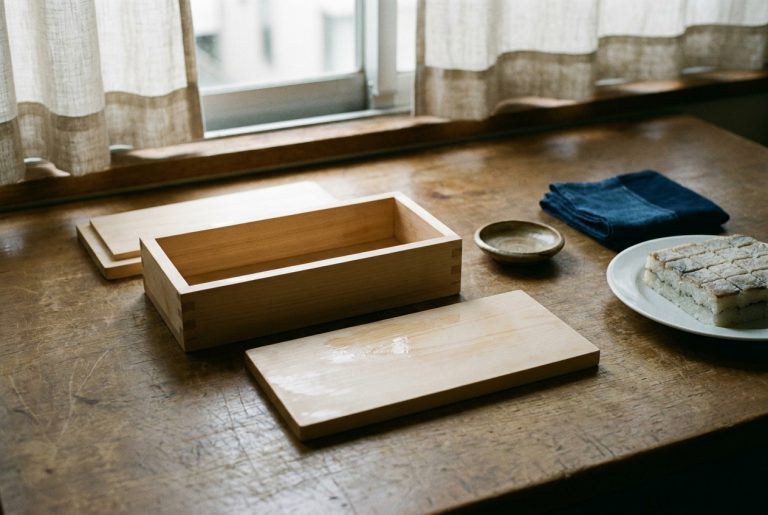
These are the two shapes you will be asked to choose between, and every English shop describes the difference the same way: the edobitsu has a cap lid with a rim that drops over the outside of the tub, the nosebitsu has a flat lid that sits on top. Sellers then tell you they are functionally equivalent, and on the evidence they are broadly right about the rice.
They are not equivalent on your shelf, and that is the part nobody prints. Because the edobitsu lid caps the body, it has to be wider than it: Shimizu’s own figures for their 18 cm box are a tub of φ17.8 cm and a lidded assembly of φ21 cm. Three centimetres of footprint you did not budget for, on a piece of kitchen equipment whose real constraint is where it lives when it is not in use. The nosebitsu stays inside its own diameter.
So: buy the edobitsu if you like it and have the shelf, buy the nosebitsu if you are fitting it into a cupboard, and do not let anyone sell you either one on performance.
First use, and the wash that decides how long it lasts
A new ohitsu tastes of the mill. The instruction one Japanese exporter gives with theirs is to soak the box and lid for two hours in water with about half a cup of vinegar in it before the first use, which pulls the raw woodiness out; the water going faintly brown at this stage is normal, and anyone who has started a wooden drop lid or a new hangiri has seen it.
- Wash under running water with a stiff brush — a tawashi — and no detergent. Soap gets into open grain and comes back out into your rice.
- Never soak it after use, and never leave it standing full of water overnight.
- Dry it properly: upside down, off the counter so air reaches the base, for several hours. This is the step that decides whether you still own it in five years.
- Makers do not sell wooden ohitsu as dishwasher or microwave pieces, which is the practical reason the ceramic ohitsu category exists at all — Banko-ware boxes from Mie are listed explicitly as fridge-and-microwave items. For the general question of what may go in either machine, we keep a separate guide.
Beyond that, follow the sheet that came with your box rather than a stranger on the internet, including me: makers differ on the details, and a wooden vessel that is stored damp will develop problems that no general advice can address at a distance. If you want the broader principles for living with unglazed and untreated surfaces, our care guide and the urushi guide cover the same ground for ceramics and for lacquer.
When not to buy an ohitsu at all
This is a ¥11,000–18,000 wooden object — roughly $80–120 — that asks for a brush, a drying rack and a habit. It is worth it for a specific person, and a waste for several others.
- You cook one or two gō and eat it straight away. Nothing is being held, so nothing is being solved. Put the rice in a decent chawan and enjoy it.
- Your leftovers go to the fridge or the freezer. The wooden box is not sold for either job. The ceramic ohitsu is.
- You do not have anywhere to air it. A wet wooden tub that lives in a closed cupboard is a problem you have bought on purpose.
- You want it for the look. It is genuinely lovely, and the copper bands age well. But it is a working tool and it shows its work, so buy it to use.
The person it is for is easy to describe: you cook a full pot in the morning or the evening, the rice sits for two or three hours while people eat at different times, and you have been quietly annoyed by what the keep-warm setting does to it. That is the whole market for this object, and if you are in it, the box is very good at its one job.
The short version
- The millilitre figure on the listing is gō × 180. It counts dry rice, not the volume of the box. An “630 ml” ohitsu holds nearly 1,800 ml.
- Match the ohitsu to your rice cooker: 3-gō cooker → 18 cm; 5.5-gō cooker → 21 cm. Do not size up.
- It does not keep rice warm. It moves moisture out of the rice and into the wall.
- Sawara over hinoki, because it smells less. Ignore “antibacterial.”
- Edobitsu vs nosebitsu is a shelf-space decision, not a performance one: the cap lid adds about 3 cm to the diameter.
- No soap, no soaking, dry it upside down. If you cannot commit to that, buy ceramic.
If you are assembling the Japanese rice setup properly, the other two pieces are the shamoji for turning the rice out without crushing it and, if sushi is on the menu, the hangiri. All three are the same wood doing three different jobs with water, which is most of what there is to understand about a Japanese kitchen in wood.
And if the rice itself is what you are working on, cooking it in a donabe and the main tableware guide are the next two stops.
Disclosure: Nagori Ware is an independent editorial guide written from Japan. Some links elsewhere on the site are affiliate links. Parts of this site are drafted with AI assistance and checked against Japanese sources. General information, not legal or safety advice.