Tonsui: The Japanese Hot-Pot Bowl Sized for Your Hand, Not Your Appetite
Two shops in the United States will sell you a tonsui today. One files it under “Tonsui Dipping Saucer”: 4.53 inches across, 5.2 fl oz, $3.80. The other calls it a hot-pot bowl for individual portions: 13 cm, porcelain from Gifu, $28. Both are using the word correctly. Neither page mentions that the other kind exists.
So the first thing to know about a tonsui is that the word is doing two jobs. It covers a shallow saucer that holds tempura dipping sauce, and it covers the bowl you eat a whole evening of donabe hot pot out of. They look almost identical in a photograph, and — this is the part that costs people money — the wider one is often the smaller one.
The reason is simple once you see it. A tonsui’s width is not set by how much food goes in. It is set by how wide a bowl your hand can hold while the bowl is full of near-boiling broth. Volume comes from depth, and depth is the number that almost no listing prints.
What a tonsui is, and why it carries a spoon’s name
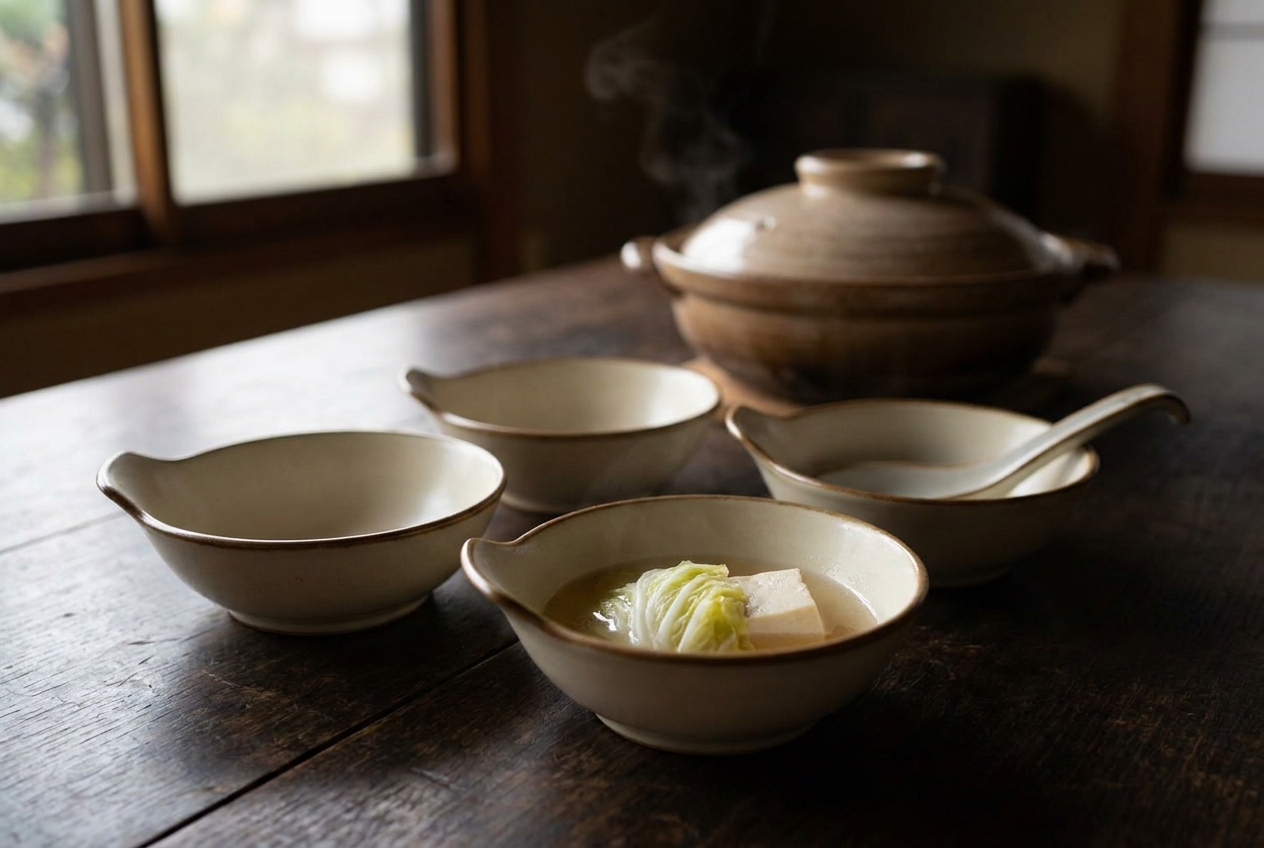
Japanese reference works define it in one line: tonsui is a small bowl with one part of the rim slightly protruding. That is the entire definition. Not a handle — a protrusion. Everything else about the object, including its size, follows from what that protrusion is for.
The written form you will see on Japanese product pages is 叛水, which reads literally as “drink water.” Japanese reference entries say the bowl was originally used to scoop water out of a storage jar and drink from it, which would explain both the name and the pouring lip.
There is a second written form, 湯匙, and this one is stranger. In Chinese, tāngchí is the word for the ceramic soup spoon — the flat-bottomed one that comes with ramen. One account has that Chinese word arriving in Japan and being heard as tonsui; a third account says it is simply dialect from the Nagasaki region. None of the three is settled, and anyone who tells you otherwise is picking a favourite.
What is not in dispute is the oddity that follows. The Chinese word for the spoon ended up on the bowl, and the spoon itself got a different name altogether — chirirenge, a fallen lotus petal. Two objects, and each is wearing the other’s label. Japanese references now explicitly distinguish the two, which tells you the confusion is old enough to have needed sorting out.
What size tonsui to buy: 12 cm is the line, and it is about your hand
Japanese buying guides give a figure for the average tonsui on sale: about 12.5 cm wide and 4.5 cm high, measured with the lip excluded. Capacities cluster around 240–380 ml. Those two numbers together describe a bowl that holds a serving of hot pot — broth, a piece of fish, some cabbage, a block of tofu — and can be picked up with one hand.
The same guides then draw a line that surprises most Western buyers. Around 12 cm is the easy size to lift as a hot-pot bowl. At 13 cm and above, the bowl stops being recommended for nabe and starts being recommended for salad and side dishes.
Bigger is not better here, and it is worth being clear about why. On a Japanese table, small vessels are picked up rather than eaten from where they stand. A bowl you cannot hold securely in one hand has failed at the job, no matter how much it holds. The upper size limit is set by your palm, not by your appetite.
Which brings us back to the trap at the top of this page. The cheap ceramic tonsui sold by restaurant suppliers abroad are 4.25–5.1 inches wide and hold 148–169 ml. They are the right width and roughly half the depth. One of them — the widest in the range, 5.1 inches — holds 169 ml, which is less than a small Japanese tonsui 2 cm narrower. They are dipping saucers, and the shop that sells them says so in the category name. It is the marketplace listings copying that photograph who leave it out.
Read the millilitres, and know which width you are being given
Two widths often appear in a listing, in this order: bowl, then bowl-plus-lip. A tonsui described as 13 × 15 cm is a 13 cm bowl with a 2 cm lip on it. Japanese listings quote the width with the lip left out; shops abroad are less consistent, and a single figure could be either. If you only get one number and it is bigger than about 14 cm, assume it includes the lip.
The number that settles everything, though, is the capacity in millilitres. It is on almost every Japanese listing and almost no English one. If you cannot find it, the price is a crude stand-in: under $10 is a dipping saucer, and $20–30 with “hot pot” in the description is a serving bowl. That rule is not elegant, but it has not been wrong yet. Reading the gaps in a Japanese tableware listing is a general skill worth having.
Four tonsui on sale, side by side
| Bowl | Width | Depth | Holds | Price |
|---|---|---|---|---|
| Melamine, US restaurant supplier | 10.8 cm (4.25 in) | — | 148 ml | $6.80 |
| Ceramic, US restaurant supplier | 11.5 cm (4.53 in) | 4.1–5.0 cm | 150 ml | $3.80 |
| Ceramic, US restaurant supplier | 13.0 cm (5.1 in) | — | 169 ml | $4.80 |
| Mino stoneware, Japanese maker | 12.9 cm | 4.8 cm | not published | $23 |
| Mino porcelain, ring handle | 13 cm (15 cm with the ring) | 5.5 cm | not published | $28 |
| Japanese market average | 12.5 cm without the lip | 4.5 cm | 240–380 ml | — |
Note what the two Japanese makers leave out, and what the American supplier puts in. The supplier publishes fluid ounces because restaurants buy by volume; the craft shops publish millimetres because customers are buying an object. Between them, nobody gives you both.
Why the lip faces left
Set a Japanese table with tonsui and the lips all point the same way: left. This is not superstition and it is not symmetry. You lift the bowl with your left hand, because your right hand has the chopsticks in it. Turn the lip towards the hand that is going to do the work.
This makes the tonsui the mirror image of the other vessel on this site that is built around one specific hand. A side-handle kyusu is made for a right hand and quietly punishes a left-handed user. A tonsui is made for a left hand — and if you are left-handed, you simply turn it round and lose nothing, because the bowl is symmetrical and only the placement has a side.
The grip itself is worth thirty seconds of practice, because the obvious way is the wrong way. Do not pinch the lip between finger and thumb: two fingers, a full bowl of hot broth, and a glaze with condensation on it is exactly how these get dropped. Lay the thumb on the lip and let the other four fingers spread under and along the body. The lip is not carrying the bowl; it is stopping the bowl from rotating while your hand carries it. Japanese sources are also clear that there is no formal etiquette here — hold it however it feels secure.
And the reason a thick, heavy tonsui is not a worse one: earthenware is thick enough that the heat takes a while to reach the outside. That is the whole argument for the clunky one over the elegant thin one, and it is a hand argument again, not a taste argument.
The sloped lip is a spoon rest, and almost nobody says so
Japanese guides separate the protruding-lip tonsui into two: shallow flaps, and longer flaps with a slope to them. The sloped kind exists so you can hook a renge across it and park the spoon without putting it on the table. If you eat hot pot the way it is eaten at home — chopsticks for the solids, a spoon for the broth — that groove is used at every meal. If you are buying one bowl to also serve dressing and olives, the shallow flap looks less strange next to Western plates.
The third shape is a closed ring instead of a flap, large enough to put a finger through. Japanese guides recommend it specifically for small children and for older hands, on the grounds that a finger through a ring does not need a working thumb or a dry grip. It is also the most expensive of the three, because the ring has to be formed and fired as part of the body.
What to buy
Buy this, not that
For hot pot: buy 12–13 cm wide, at least 4.5 cm deep, 240 ml or more, and buy one per person plus one. Don’t buy the $4–7 “tonsui” from a restaurant supplier for nabe — at 148–169 ml it is a tempura dipping saucer, and you will refill it four times an evening. Do buy exactly that saucer if dipping sauce is what you wanted; it is the correct object and it costs four dollars.
The one-per-person-plus-one is not padding. Tonsui break, and they break in the way small lifted vessels always break — on a hard sink, not at the table. Buying a set of four and then finding the pattern discontinued two winters later is the standard way this goes wrong.
On material, the Japanese guides sort by it for a practical reason. Porcelain is thin, light, strong, and absorbs almost nothing, so it does not stain. Earthenware is thicker, which is why it keeps the food hot and keeps your fingers comfortable. Melamine is unbreakable and is what you want if children are carrying bowls. Those are real differences, and none of them is about looks.
Whether any particular bowl can go in the microwave or the dishwasher is a question only the maker’s own note answers, and it varies within every one of those materials. The two Japanese pieces above are both marked microwave- and dishwasher-safe; plenty of others are not. Check the listing rather than the material, and see our guide to which Japanese bowls are microwave and dishwasher safe. General care for Japanese ceramics is covered separately.
If you are buying Japanese-made, most tonsui you will find are Mino ware from Gifu. That is not a compromise. Mino is the region that supplies the ordinary dishes of Japan by volume, and it is the right place to buy a bowl you intend to use forty times a winter rather than admire.
Do you need tonsui at all?
If you do hot pot once a winter, probably not. Any small Japanese bowl of roughly the right size will hold a serving, and the lip only earns its keep once holding the bowl one-handed has become a thing you do repeatedly. Honest answer: the tonsui is a frequency purchase.
There is one thing it is definitely not, and the confusion is common enough to be worth naming. A tonsui is not a tsukemen dipping bowl. Tsukemen wants a deep, heat-retaining bowl that keeps concentrated broth hot while you dip cold noodles into it; that is a different shape doing a different job, and it belongs with the noodle bowls. A tonsui is shallow and open, and concentrated broth in one goes cold by the third mouthful.
What it pairs with, if you are building the table rather than buying one thing: a donabe to cook in, a tray under it, the tonsui to eat from, a renge each, and a small dish for the ponzu. That is a complete nabe setting, and the tonsui is the only part of it most people abroad have never heard of.
Questions people actually ask
Is a tonsui the same as a kobachi?
No. Kobachi is the general word for a small Japanese bowl, and a tonsui is one kind of it — the kind with the protruding lip. Shops sometimes file tonsui under kobachi, which is correct but unhelpful when you are searching.
Can I use a tonsui for something other than hot pot?
Yes, and in Japan they are used year-round for simmered dishes, pickles, tempura dipping sauce and noodle dipping sauce. The 13 cm and wider ones get bought for exactly this reason. The bowl only stops working when the food is meant to stay hot and you are not holding it.
How many should I buy for four people?
Five. One each and a spare, as above. If you also want dipping-sauce dishes on the same table, buy those separately and small — putting ponzu in a 300 ml tonsui looks like you have misjudged the portion.
Why is the lip always on the same side in photographs?
Because the photographs are shot the way the bowl is set: lip to the left. It is not a left-hand-only object — it is a lifted object, and in a Japanese setting the lifting hand is the left one.
The useful thing about the tonsui is how honestly it admits what Japanese tableware is doing. A Western bowl is sized by the portion, because it stays on the table. This one is sized by the hand, because it does not. Once you know that, the 12 cm line stops looking arbitrary, the lip stops looking decorative, and the $4 saucer with the same silhouette stops looking like a bargain.
Related guides
- Japanese donabe: choosing and seasoning a clay pot — the pot the tonsui is filled from, and how to season a new one
- The renge, and why ramen is the bowl that gets a spoon — the spoon whose Chinese name the tonsui borrowed
- Japanese bowl etiquette: which bowls you lift — why Japanese vessels are picked up, which is what sets the 12 cm line
- Left-handed? Read this before buying a kyusu — the mirror case, a vessel built around the other hand
- Japanese tableware sizes and terms — sun, gō and the rest of the unit key behind Japanese sizes
- Japanese small dishes — kobachi, mamezara and the rest of the small-bowl family
- What size seiro steamer to buy — the steamer that shares the same burner on a winter table
- Japanese tableware and dinnerware — the pillar guide to building a Japanese table from nothing
Disclosure: Nagori Ware is an independent editorial guide written from Japan. Some links elsewhere on the site are affiliate links. Parts of this site are drafted with AI assistance and checked against Japanese sources. General information, not legal or safety advice.