The Lid on a Donburi Bowl: What It Actually Does to Your Food
A donburi lid is not a warmer. It is a steamer with no heat of its own.
Every English shop selling one says the same short thing. Akazuki, selling a pair of Hasami bowls with matching lids for $54.95, puts it as “Keep food warm at the table with matching ceramic lids.” That is the whole explanation you get, across the category. Meanwhile the Japanese reference on donburimono says something that nobody has translated for you: for tendon and katsudon, if you want to keep the crisp bite of the coating you do not use a lid — and there are long-established tempura shops that treat the steamed, softened state as the finished dish.
Read those two sentences together and the purchase changes shape. The lid is not a thermos. It is an instruction about what the food is supposed to become by the time it reaches your mouth, and the two camps in Japan disagree about it on purpose. Once you know that, the rest of the decision — what it costs, where it goes in the cupboard, whether it can double as a plate, which dishes it ruins — falls out of one fact: the lid has no heat. It only decides where the water goes.
The rice is the heat source. The lid is not.
A tempura shop owner writing about why he covers his tendon says it in one clause: the heat of the rice steams the tempura and the tare and drives the flavour in, so that the bowl becomes one thing rather than three. The rice does the work. The lid just refuses to let the steam leave.
And steam that cannot leave has to go somewhere. It goes onto the lid, which is cooler than the rice, and it stops being steam there. That is what the droplets are: water handing its warmth to the ceramic. Then the droplets fall, straight down, onto whatever you put on top of the rice.
If this sounds like an argument from first principles rather than something anyone has measured, here is a Japanese manufacturer measuring it. Panasonic’s support page for rice cookers explains why kept-warm rice goes watery, and the mechanism is exactly this one: when the cooker switches from cooking to keeping warm, the inside begins to fall towards the lower holding temperature, and dew forms. Hold a small amount of rice and the holding temperature drops further to avoid drying it out, so more dew collects on the lid plate and the inner pot. Their instruction is blunt — open the lid the moment the buzzer sounds, and turn the rice over from the bottom to let the excess steam out.
A rice cooker is not a donburi bowl, and hours are not minutes. But the Japanese kitchen’s standard answer to the same problem gives the game away: when you steam something you do not want wet, you line the inside of the lid with a cloth so the droplets are caught before they fall. Nobody does that with a donburi. On a donburi the droplets are allowed to fall, because on a donburi they are wanted.
Which bowls of food want it, and which it ruins
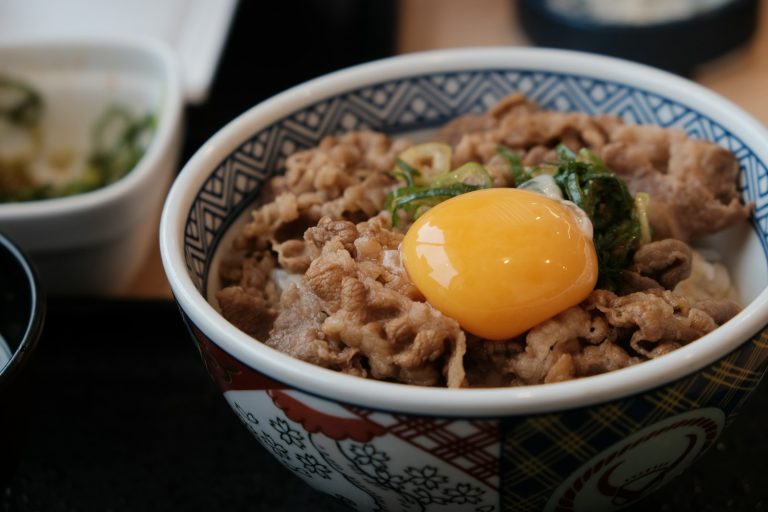
Start with the dishes that were built around a lid. Unagi over rice goes back to the Bunka era, 1804 to 1818; tendon arrives from the end of the Edo period; gyudon and kaikadon in early Meiji; oyakodon around the end of the nineteenth century; katsudon somewhere between Meiji and Taisho. These are not a random set. They are all a hot, sauced topping sitting on hot rice, and in every one of them the sauce is supposed to reach the rice.
That is the lid’s actual job. A cooking-science site lists four effects and only one of them is temperature: the food steams to the right doneness, the aroma of the topping transfers into the rice, the aroma rises at you when the lid comes off, and the bowl cools more slowly. Three of the four are about flavour and theatre. The tempura shop owner adds a fourth that no listing mentions and compares the moment to opening a station bento box.
Now the other side. If you are making karaage-don, or tempura you intend to eat crisp, or anything whose whole appeal is a dry surface, the lid is working against you with no off switch. You cannot have the aroma trapped and the coating crisp; they are the same water. The honest Japanese position is that both answers are legitimate and the shop picks one — whether a bowl is lidded, the reference notes, depends on whether it is going out for delivery and on which dish it is. Delivery is the clearest case: a bowl that has to travel for fifteen minutes has already been steaming itself the whole way, which is why the lid became standard for food that leaves the kitchen, and why it is close to pointless if you are carrying the bowl four metres to your own table and eating it immediately.
Buy this, not that
Buy the lid if food reaches your table late — delivery, a household that eats in shifts, or the sauced rice bowls the lid was invented for. Don’t buy it for anything you want crisp: a lid turns tempura coating soft within the time it takes to walk to the table, and that is not a defect you can work around. If crisp is the point, spend the same money on a wider bowl instead — 15 to 17 cm across, 540 to 600 ml — and let the steam go.
Look at the hole. It tells you what the lid is for.
Here is a check you can run on a product photo in two seconds, and I have not seen it in an English buying guide. Find the lid. Look for a hole in it.
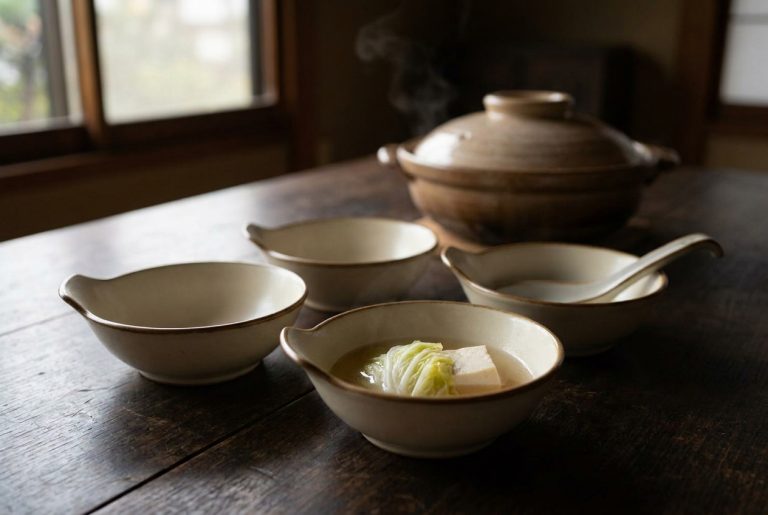
A large hole in the centre means you are looking at a cooking part, not tableware. That hole exists on the lids of the little pans used for oyakodon, katsudon and tamagodon, where the egg has to be set in steam without the broth boiling over the edge. A small hole means a donabe lid, and Japanese sellers give two reasons for it: the shape of an earthenware pot puts the food and the water right up against the lid, so there is very little room for steam to be held, and a clay pot is breakable, which makes a lid that could be lifted off by pressure a genuinely bad idea. Our guide to replacing a donabe lid goes into what happens when that fit is wrong.
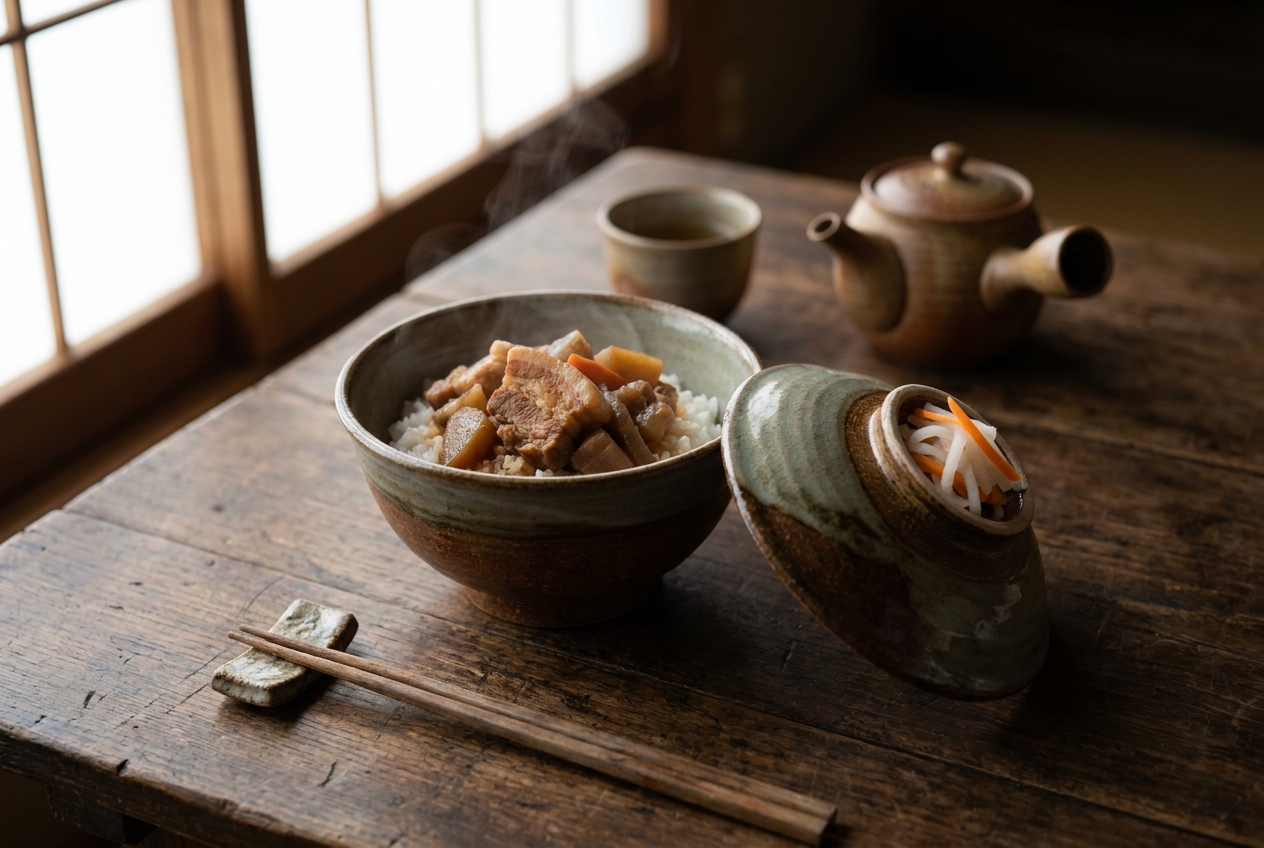
A donburi lid has no hole, and that absence is what makes it the one lid you can eat off. In Japanese a lid without a hole has its own word, ooi, and the practice of using it as a vessel is not a shortcut invented by tired people: it appears in kaiseki and in Zen temple meals, where the inverted lid holds the pickles. The donabe for Nagoya’s miso-nikomi udon has no hole for exactly this reason, and the lid arrives as your side plate. TOIRO, selling a Mino-ware bowl and lid for $120, is one of the very few English shops that says it out loud: “The fitted lid is more than just a cover—it can be flipped over and used as a small bowl or plate, adding extra versatility to your table.” The tempura shop owner goes one step further and uses the lid as a staging area, lifting the tempura onto it so he can get at the rice underneath.
I will not pretend this is universally approved. In a Japanese discussion of the practice, the dissenting view was that it looks impoverished and that a lid with a vent hole will leak onto your table — the vent hole objection is correct, which is the whole point of checking. The accepted answer went the other way and cited the kaiseki and Zen precedent. If you want the broader map of what is and is not considered careless at a Japanese table, we cover it in which bowls you lift and which you leave on the table. For a lid specifically: no hole, and you are on solid ground. And if the lid is doing duty as a small dish, it is worth knowing what a dedicated kozara costs before you decide the lid has saved you anything.
One more thing the lid quietly buys you: height. The Japanese reference notes shops that pack the topping up into the lid itself, building a mound well above the rim. A lidded bowl can be filled past the point where an open bowl would spill, which is a real difference if you are feeding someone who eats a lot and the alternative was buying a bigger bowl.
The lid barely moves the price. It costs you in grams and shelf space.
I expected to find a lid premium and there isn’t one worth naming. Here is what the same category actually costs, with the lid status in the last column.
| Bowl | Size and capacity | Price | Per place setting | Lid |
|---|---|---|---|---|
| Kujira, Mino, set of 4 | 13 × H7 cm, 340 ml | $48.95 | $12.24 | No |
| Kosoe, pair with lids | 540 ml each | $43.95 | $21.98 | Yes |
| Nami, Japan, pair with lids | 15 × H10.5 cm, 540 ml, 545 g | $54.95 | $27.48 | Yes |
| Earth White, Hasami, single | 15.5 × H10 cm, 340 g | $50.00 | $50.00 | No |
| Ponyo, single with lid | — | $64.95 | $64.95 | Yes |
| TSUKIYO, Mino, bowl and lid | 16.8 × H12.8 cm, 650 g; lid 15.5 × H5 cm, 325 g | $120.00 | $120.00 | Yes |
Look at rows three and four. A pair of 15 cm Japanese bowls with lids works out at $27.48 a setting. One lidless Hasami bowl of almost identical diameter, 15.5 cm, from a specialist shop, is $50. The lid is not what sets the price in this category. The maker and the shop are. Anyone telling you to skip the lid to save money has the arithmetic backwards.
What the lid does cost is physical. On the TSUKIYO set the bowl is 650 g and the lid is 325 g: the lid is half again the weight of the thing it covers, and you wash it, dry it and find a home for it every single time. Worse, lidded bowls do not nest. Four open donburi stack into one column; four bowls and four domed lids are two columns of different diameters, and the lids are the awkward one — 15.5 cm wide and 5 cm tall, with a knob that stops you putting anything on top. That is the real reason to think twice, and no listing mentions it because shelf space is not a product feature. We wrote about this habit of listings omitting the part you need in how to read a Japanese tableware listing.
Buy this, not that
Buy one or two lidded bowls, not a matched set of four. The lid earns its keep on the bowl that gets carried, covered or served late, and a set of four means eight pieces in two incompatible stacks for food you will usually eat straight away. Don’t pay extra for the lid expecting warmth — at $21.98 to $27.48 a setting, lidded Japanese bowls undercut a single $50 lidless one from a specialist shop. You are paying for the maker, not the cover.
Two questions this article is not going to answer
How long food can safely sit under a lid is not a question about the bowl. It depends on the food, the room and how hot it was when you covered it, and a ceramic lid does nothing to change the answer. We are not going to put a number on it here.
Whether a given bowl or lid can go in the microwave or the dishwasher is likewise not something to infer from the material, and makers’ own statements vary wildly within this very table: the Nami pair is published as microwave- and dishwasher-safe but not oven-safe, while the TSUKIYO set is published as none of the three. The lid and the bowl can also carry different answers, so check both. Our dedicated piece on whether Japanese bowls are microwave and dishwasher safe is where that question belongs. The only reason to raise it here is that a lid you cannot microwave turns a reheat into a two-step operation, and if that matters to you, heat-resistant glass is a category that exists — HARIO’s glass donburi, 156 by 132 mm and 600 ml, sells in Japan at ¥4,400 including tax precisely because its lid is the same material as its bowl.
If you are buying one anyway
The donburi range in these listings is consistent: 15 to 17 cm across, 10 to 13 cm deep, 540 to 600 ml. Below roughly 14 cm and 400 ml you have bought a rice bowl with a lid on it, which is a different object — the rice bowl sizes are here, and the line between a donburi and the deeper bowl people confuse it with is in ramen bowl versus donburi bowl. For the full size ladder and what each one is for, start from our donburi bowl guide.
Then check two numbers the photo will not give you. First, the lid’s own diameter against the bowl’s: TSUKIYO’s lid is 15.5 cm on a 16.8 cm bowl, which means it drops inside the rim rather than sitting over it — a tighter seal, more condensation, and a lid you cannot put down on a wet counter without it picking up what is there. Second, published capacity is measured to the brim on Japanese listings, so a 540 ml bowl holds comfortably less than 540 ml of food; the same trap runs through soup bowl capacities.
And if what you actually want is a lid that cooks — one that holds steam in deliberately, for a long time, on purpose — you are not looking for a donburi at all. You want the lidded cup built for exactly that, which we cover in chawanmushi cups, or the weighted lid that sits directly on the food in a simmering pot, the otoshibuta. The donburi lid is the modest member of that family. It holds the steam for four minutes and gives you the smell when you lift it, and that is genuinely all it was ever asked to do.
Disclosure: Nagori Ware is an independent editorial guide written from Japan. Some links elsewhere on the site are affiliate links. Parts of this site are drafted with AI assistance and checked against Japanese sources. General information, not legal or safety advice.