Japanese Lacquerware (Urushi): How to Tell Real Lacquer From Plastic Before You Buy
Two Japanese soup bowls, one at $18 and one at $180, photograph almost identically. Nobody is hiding anything. Both are smooth, dark, seamless surfaces, and a camera can only see surfaces. One of them is a sprayed film over moulded plastic. The other is a block of wood turned on a lathe, wrapped in cloth at the rim, and built up in dozens of hand-applied coats of tree sap. The photograph cannot separate them. The label can.
Japan’s household goods quality labelling rules require anything made for eating or serving and coated in urushi — or in one of its substitutes — to declare two facts: what the base is made of, and what the coating is. Those two lines predict everything you will later care about. How warm the bowl feels when it is full. How heavy it is at the end of your arm. Whether it can go near a dishwasher. Whether it can be repaired in twenty years, or thrown away in three. Whether $180 is a fair number.
So this guide is built around that pair rather than around regions or dynasties. Learn to read two lines, and the rest of the decision is arithmetic.
Japanese lacquerware — shikki — is a bowl, tray or box built up in coats of urushi, the sap of the lacquer tree, over a base of wood or moulded plastic. Japanese labelling law requires both facts on the box: what the base is, and what the coating is. Those two lines are the difference between an $18 bowl and a $180 one.
The vocabulary on the label
Four items are required on Japanese lacquerware: the product name, the type of surface coating, the type of base, and handling cautions. English shops usually compress these into “Material” and “Finish”; the better ones keep the Japanese words alongside. This is the decoder.
| On the label | How it appears in English | What it physically is | What it means for you |
|---|---|---|---|
| 漆塗 / 本漆 (urushi-nuri) | “urushi lacquer”, “natural lacquer” | Sap of the urushi tree, hardened by humidity rather than dried | Warm to the touch, deep rather than flat, can be re-lacquered. Hand wash only |
| カシュー塗 (cashew) | “cashew lacquer”, “cashew coating” | A paint made from cashew-nutshell liquid | Looks close to urushi at a third of the price. Still not dishwasher work. Not urushi |
| ウレタン塗装 (urethane) | “urethane coating”, “resin finish” | A sprayed polyurethane film | Tough and cheap. Often dishwasher-safe. Cannot be re-coated once it wears |
| 天然木 (tennenboku) | “natural wood” | Solid wood turned from one block — zelkova and horse chestnut are common | Light for its size, warm, quiet. Takes any coating well |
| 木粉樹脂 / 木質樹脂 | “wood composite”, “wood powder resin” | Wood flour bound in resin and moulded | Heavier than wood, cheaper, more uniform. The honest middle |
| 合成樹脂 / ABS | “resin”, “melamine” | Plastic | Cool in the hand, nearly indestructible, frequently dishwasher-safe |
| 布着せ (nunokise) | rarely translated; look for “cloth” | Hemp or cotton cloth bonded over the rim and foot before undercoating | The best durability tell there is. A cloth-reinforced rim does not chip through |
One rule before that table becomes a trap. If a listing states neither the base nor the coating, assume the cheap combination. Makers who use urushi say urushi — it is the expensive part of the object, and nobody buries it in a footnote.
Four combinations, four different objects
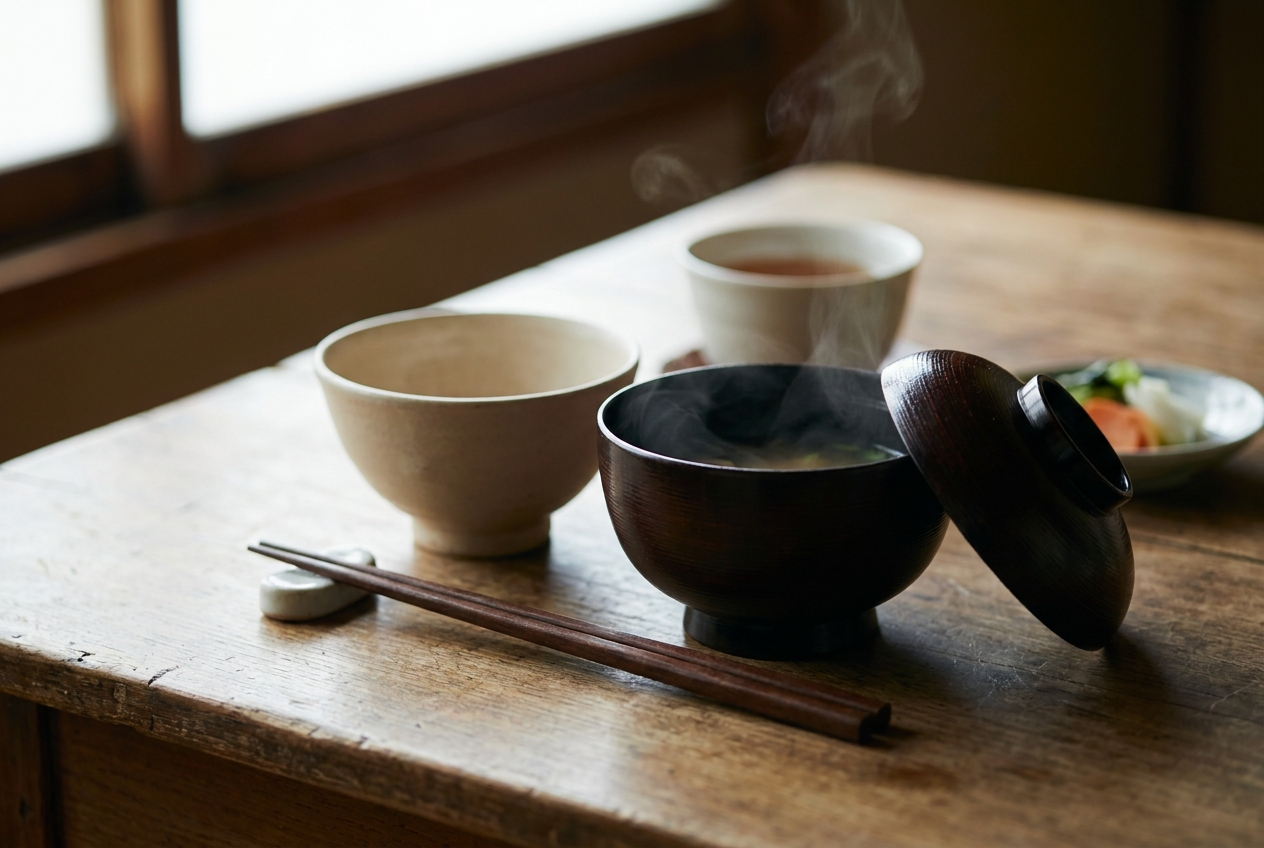
The top-left box is the object people mean when they say “Japanese lacquerware”. Wood is a poor conductor, so a bowl of miso soup hot enough to steam sits in your palm without burning it, and the bowl itself reaches your body temperature within a few seconds. Nothing else on the table does this. It also means an urushi bowl is repairable: worn coats can be built back up by a lacquerer, which is why families keep them for two or three generations rather than replacing them.
The top-right box — wood under a urethane film — is where I would send almost everyone first. You keep the lightness and most of the warmth, because those come from the wood, not the finish. You lose the repairability and the visual depth. In exchange, a fifteen-minute soak while you answer the door is an annoyance instead of a disaster.
The bottom-right box deserves less contempt than it gets. A resin bowl with a urethane finish is a genuinely good answer for a household with small children, for outdoor eating, or for the eight extra bowls you need twice a year. It will feel cool and slightly dead in the hand, and it will still be intact when the urushi one is being restored. Just do not pay $60 for it.
The bottom-left box — urushi over a resin body — is the one to look at twice. It exists mostly for temples, restaurants and banquet caterers who want the surface without the cost of solid wood. There is nothing dishonest about it, but you inherit the urushi care rules while giving up the warmth that was the reason for urushi in the first place.
Buy this, not that
Buy natural wood with a urethane finish for your first lacquer bowl — roughly $40–90, warm, light, and forgiving of the one night it sits in the sink. Don’t start with a $250 Wajima bowl. It is the better object, but it wants hand-washing and immediate drying every single day, and a treasured bowl that lives in a drying rack of guilt is a wasted purchase. Buy that one second, once you know you actually like eating from wood.
What is under the surface, and why the price moves so far
Urushi does not dry. It cures — the sap polymerises by taking up moisture from humid air, which is why lacquer workshops are damp rooms rather than warm ones, and why a coat takes a day or more rather than an hour. Each coat is thin, each one is hardened, sanded and polished before the next, and the structure that results is a laminate rather than a paint job.
The undercoat is where the money goes, and it is invisible. In Wajima, on the Noto peninsula, the undercoat is lacquer mixed with jinoko — a fired, powdered diatomaceous earth dug locally, full of microscopic pores that the lacquer sinks into and grips. Cloth is bonded over the rim and the foot ring first, because those are the two places a bowl meets the world. Wajima pieces are commonly described as passing through something in the region of a hundred or more separate operations, divided among specialists who each do one thing. In 1977 it became the first lacquerware in Japan designated an Important Intangible Cultural Property.
That is why a Wajima bowl costs what a mid-range dinner service costs, and it is also why the price is not arbitrary. You are buying labour that has already happened and cannot be seen.
What the place name is telling you
Regional names in lacquer work differently from regional names in Japanese ceramics, because lacquerware is made by a chain of separate trades and the trades are not in the same town. There is an old line about it in Ishikawa: Yamanaka for the wood, Wajima for the lacquering, Kanazawa for the gold decoration.
Yamanaka, in Kaga, is the wood. It is Japan’s largest producer of turned wooden cores, descended from itinerant woodturners who settled upstream of the hot springs. If a listing says Yamanaka, expect crisp turning and, often, fine horizontal ridges cut into the surface that catch the light. Wajima is the undercoat and the durability, as above. Aizu in Fukushima and Echizen in Fukui make much of the everyday and commercial ware you will meet without noticing. Kiso in Nagano works in a plainer register that suits a modern table. Tsugaru in Aomori is the outlier — layered colours polished back through each other into a mottled pattern, and unmistakable once you have seen it.
What none of these names tells you by itself is the coating. Yamanaka produces urethane-finished bowls by the container load alongside urushi ones. The place name describes provenance; the label describes the object.
The decoration has names too, and you can feel which one it is
The label will often carry a second word after the place name — maki-e, raden, chinkin. These are not styles or motifs. They are different physical operations, and each one leaves the surface at a different height. Which means you do not need to trust the listing: you can run a fingertip across the pattern and find out which technique you are holding.
Maki-e (“sprinkled picture”) is the broad family. The artisan draws the design in wet lacquer and sprinkles gold, silver or coloured metal powder onto it before it sets, then seals and polishes. It splits three ways by relief. In hiramaki-e, the flat version, the design sits just slightly proud of the surrounding surface — you can feel a faint edge. Takamaki-e builds the motif up in high relief, with the lacquer thickened into a modelling paste using charcoal or clay powder and sculpted before the metal goes on; it is unmistakable under a finger. Togidashi maki-e does the opposite: the whole object is coated over in black lacquer after the metal is fixed, then polished back down until the buried design reappears perfectly flush. You can see the picture and feel nothing at all.
Chinkin goes the other way again — the pattern is carved into a surface already built up in layers of lacquer, and gold is pressed into the incisions. The design sits below the plane, not on it, so the line catches your fingernail rather than your fingertip.
Raden is not lacquer at all but shell: thin slices cut from turban shell, abalone or pearl oyster, inlaid or laid onto the surface. It reads instantly, because shell is cooler to the touch than lacquer and the colour shifts as you tilt the piece. Hyomon, a rarer relative, does the same with sheet metal instead of shell.
Why this matters more than it looks: a photograph cannot tell you which of these you are buying. Flat gold decoration in a product shot could be hiramaki-e, could be togidashi, could be a modern printed or transferred pattern that involves no sprinkled metal and no hand at all. The listing may not say, and the price may not tell you either. Relief is the one property the picture flattens away and your hand recovers in about a second — flush, faintly raised, sculpted, or sunk below the surface.
If you are buying a piece you will eat from every day, none of this is a reason to pay more. Decoration is where the hours go, and hours are what you are paying for; an undecorated black or vermilion bowl from a good workshop will outlast a decorated one you are afraid to use. Keep maki-e for the piece that comes out a few times a year, and read the care rules below before you buy it — gold-sprinkled surfaces have less tolerance than plain lacquer for abrasion.
Thirty seconds with the bowl in your hands
If you are in a shop, or unpacking a parcel and wondering whether the description was honest, four checks settle it.
- Weight. Pick it up and expect it to be heavier than it is. A turned wood bowl surprises people by how little it weighs; a resin one weighs about what your eye predicted.
- Warmth. Hold it for five seconds and put it down, then touch it again. Wood and urushi will have taken your temperature. Resin will still feel like the room.
- The rim, against the light. Tilt the bowl until a window reflects off the surface and look along the curve. Hand-applied lacquer has faint, soft undulations in that reflection. A sprayed film has none at all, which is the point of spraying.
- The foot ring. Turn it over. On better wooden pieces you can often see the grain running through the lacquer at the foot, or the fine ridge of the turning. On moulded pieces you find a mould seam, or a suspiciously perfect circle.
There is a fifth test you can only run at home: fill it with soup. A wooden bowl of hot soup can be held in the palm, which is how it is designed to be eaten from — Japanese soup is lifted and drunk from the bowl, not spooned. A resin bowl of the same soup will make you put it down.
Sizes, and where to start
The everyday lacquer bowl is the owan, the soup bowl. Sold sizes cluster around 10–12 cm across and 180–250 ml, and most makers offer roughly three: a smaller one about 11–12 cm holding 150–170 ml, a larger one about 12–13 cm holding 180–200 ml, and a child’s size near 10–11 cm. Japanese households traditionally split these by who is eating rather than by what is in them; you can ignore that convention and simply pick by hand size. A lid adds heat retention and formality, and roughly a third to the price.
Do not buy a lacquer bowl for rice. Rice belongs in a ceramic chawan, held in the left hand while the soup bowl waits on the right, and the contrast between the two — cool glaze, warm lacquer — is half the pleasure of a properly set Japanese place setting. Nor should you buy lacquer for ramen: a ramen bowl holds a litre of boiling broth for twenty minutes, and that is ceramic territory.
The cheapest way to own real urushi
Chopsticks. A pair of genuine urushi-coated chopsticks runs $15–40 — a tenth of a bowl — and they are the piece you touch most often anyway. Look for a stated urushi coating and a slightly grippy, not glassy, tip. Skip the lacquered chopsticks sold in ten-pair bundles: those are urethane over resin, they slide against slippery food, and the coating peels at the tip within a year.
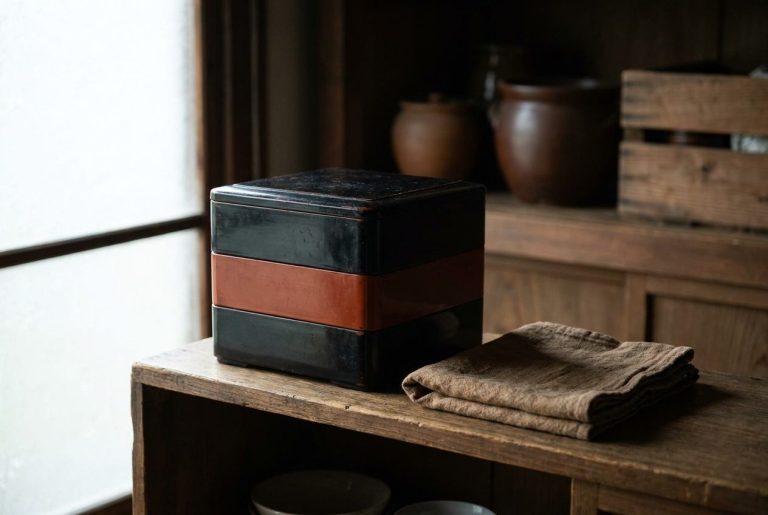
Beyond the bowl, lacquer trays are the piece most worth adding early: a tray turns assorted small dishes into a composed setting, and it does the same job at a sake service or alongside sushi serveware. Stacked jubako boxes are beautiful and are used, honestly, about twice a year.
Care: five rules, and none of them are the ceramic rules
Everything you know about looking after Japanese ceramics is close to useless here, and one habit — the long soak — is actively destructive.
- No dishwasher. Heat, water pressure and alkaline detergent together will cloud, craze or lift the coating. This applies to urushi and cashew without exception; for urethane on resin, check the label, which is required to carry handling cautions and heat limits.
- No microwave. The wooden core and the lacquer film expand at different rates. Cracks follow. If you need to reheat, the answer is a microwave-safe ceramic bowl and a transfer.
- No soaking. Wash in lukewarm water with a soft cloth or sponge and a little mild detergent, rinse, and dry with a cloth straight away. Thirty seconds, not thirty minutes.
- No direct sun. Ultraviolet light degrades urushi; a bowl left on a sunny windowsill fades and eventually crazes.
- Store somewhere that is not bone dry. Lacquer prefers the humidity it cured in. A closed cupboard is fine; on top of a radiator, or in a box with silica gel, is not.
On safety, because it comes up: cured urushi is stable and inert, and Japan has eaten from it for a very long time. The rashes urushi is famous for are caused by the raw sap, which is an occupational hazard for the people who apply it, not for the people who eat from the finished piece. Two honest caveats. A small number of people sensitive to urushi report irritation from brand-new work; airing the piece out of its box for a couple of weeks and rinsing it in warm water before first use is the standard remedy. And if you have a known urushi sensitivity, buy from a shop that will tell you precisely which coating is on the piece — cashew and urethane are different materials with different behaviour, and “lacquer” on a listing does not settle the question.
One bowl, if you only buy one
A natural-wood soup bowl around 12 cm, urethane-finished, $40–90. Use it every morning for a year. If at the end of that year you find you reach for it before you reach for anything else — and most people do, because a warm bowl in the hand is a small daily pleasure that never wears off — then buy the urushi one, and let the first bowl go to the person in your house who leaves things in the sink.
Lacquer is the one material on the Japanese table that keeps a record of being used. The sheen shifts where fingers hold it, the colour deepens, and a bowl thirty years old does not look worn so much as settled. Thirty seconds with a dry cloth each evening is the entire price of that.
Related reading
- A Guide to Japanese Tableware — the core pieces, sizes and materials of a Japanese table.
- How to Care for Japanese Ceramics — seasoning, washing and stains, for the other half of your cupboard.
- Are Japanese Bowls Microwave & Dishwasher Safe? — which pieces survive which appliance.
- The Best Japanese Dinnerware Sets — how a lacquer bowl fits into a full setting.
- Japanese Small Dishes — what a lacquer tray is for.
Disclosure: Nagori Ware is an independent editorial guide written from Japan. Some links elsewhere on the site are affiliate links. Parts of this site are drafted with AI assistance and checked against Japanese sources. General information, not legal or safety advice.