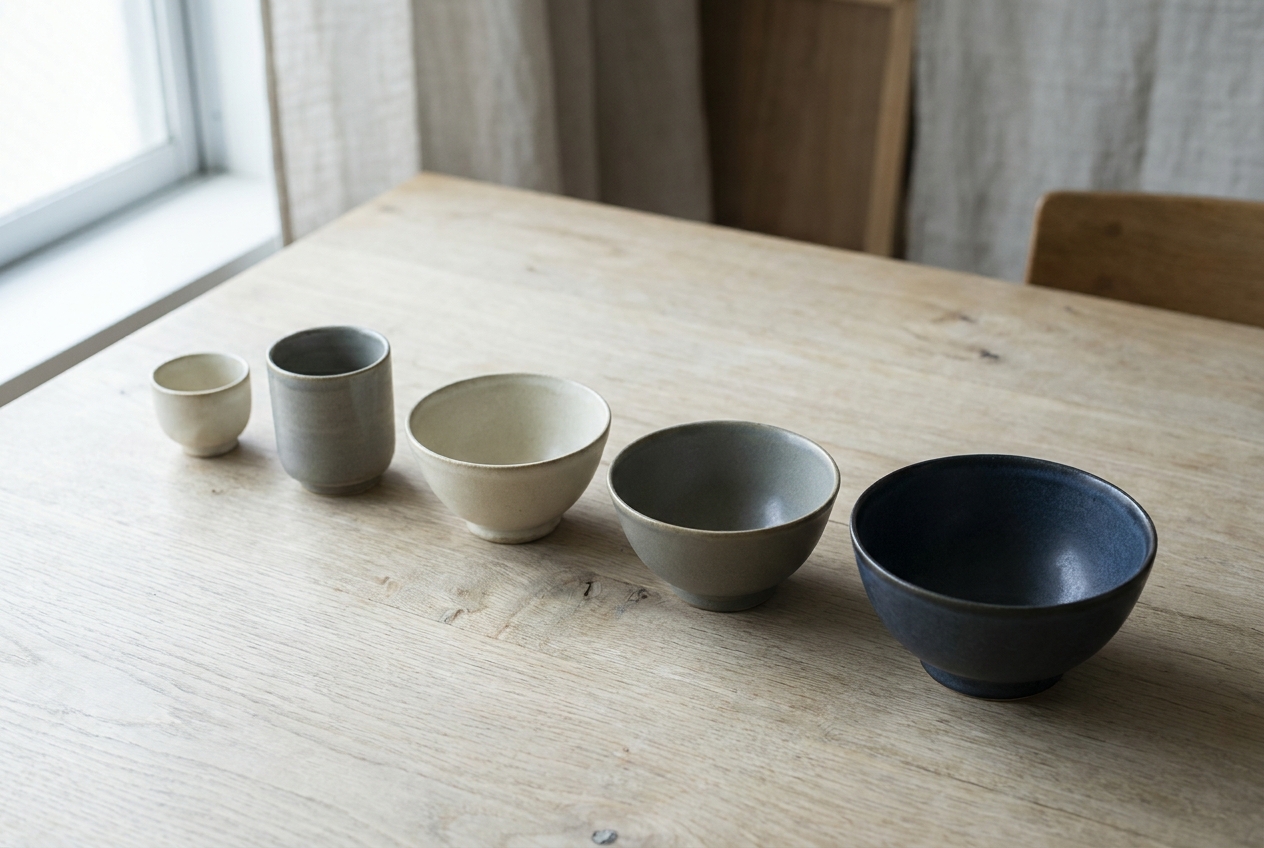
Japanese Tableware Size Chart: Bowls, Cups, Plates and Pots in cm, Inches and ml
Most Japanese tableware falls into a few size bands: a rice bowl is 11–12 cm (about 4½ in) across and holds 250–350 ml; a teacup holds 90–160 ml; a soy dish is 6–9 cm; an everyday plate is 21 cm; a ramen bowl is 20–23 cm and holds 1,000–1,600 ml. The tables below give each piece in centimetres, inches and millilitres, so you can check a listing against it in under a minute.
Japanese listings are written for Japanese buyers, and the numbers don’t always mean what an American shopper assumes. A “7-sun plate” has no centimetre figure on it. A “350 ml” bowl holds a good deal less than 350 ml of tea. A pot called “8-gō” can be one size from one workshop and another from the next. This page collects the usual sizes of each piece in one place, so you can see at a glance whether a listing is ordinary or an outlier.
Where these numbers come from. I did not measure these pieces myself. Every figure below is taken from one of our individual guides, and each of those draws on sizes published by makers and shops in Japan. Where two of our guides give slightly different ranges, the table shows the wider one and says so. Treat the ranges as typical, not guaranteed: a maker can sit outside them, and the listing for the exact piece you are buying always wins. Last checked against those guides on 18 November 2026.
Three conventions that change what the number means
1. Sizes in sun and gō are not metric. One sun (寸) is 3.03 cm, so a 7-sun plate is 21.2 cm, not 21. A gō (号) on a clay pot is a loose label for the size, not a unit. Our guide to tableware sizes and terms has the full conversion, including “6 sun 2 bu”-style sizes.
2. Capacity is quoted brim-full. Japanese sellers give the volume of the vessel filled to the rim. In use you get roughly 70 per cent of it: a teapot listed at 300 ml brews about 210 ml, and a matcha bowl listed at 350–400 ml holds a 60–80 ml serving. The miso soup bowl guide works through the same arithmetic.
3. Width is the outer rim, not the eating surface. A 12 cm bowl is 12 cm at the widest outer edge. The usable well is smaller. For flat pieces the long edge is the number, and the guide to reading a listing shows where each figure hides.
Bowls for rice, soup and noodles
| Piece | Width | Capacity | Read this first |
|---|---|---|---|
| Rice bowl (chawan) | 11–12 cm (4.3–4.7 in) | 250–350 ml (8½–12 fl oz) | Small enough to cradle in one hand. A 15 cm “rice bowl” is a Western-market size. |
| Child’s rice bowl | about 10.5 cm (4.1 in) | holds 150 g of cooked rice | 3.5 sun is the bottom rung; 4 sun (12 cm) is the adult bowl. |
| Miso soup bowl (owan) | 11.7–12.1 cm (4.6–4.8 in) | about 340 ml listed; a serving is about 160 ml | The listed capacity is brim-full, so ignore it. |
| Hot-pot bowl (tonsui) | about 12 cm (4.7 in), lip excluded | 240–380 ml (8–13 fl oz) | From 13 cm up it behaves like a salad bowl. |
| Donburi, rice-based | 14–16 cm (5.5–6.3 in) | 500–1,000 ml (17–34 fl oz) | Under 16 cm you can still lift it. Pick depth over width. |
| Donburi, noodle-based | 17–19.5 cm (6.7–7.7 in) | 500–1,000 ml (17–34 fl oz) | Sold as a bowl you leave on the table. |
| Udon / noodle bowl | 18–22 cm (7.1–8.7 in) | 900–1,500 ml (30–51 fl oz) | One deep 1,000–1,300 ml bowl covers udon, ramen and hot soba. |
| Ramen bowl | 20–23 cm (7.9–9.1 in) | 1,000–1,600 ml (34–54 fl oz) | Under about 1,000 ml the broth rides too high and the toppings crowd. |
| Matcha bowl (chawan) | 11–13 cm (4.3–5.1 in), 7–8 cm tall | 350–400 ml listed; a bowl of tea is 60–80 ml | Listed at the rim. You will never fill it. |
Two of these ranges overlap on purpose. A big donburi of about 900–1,000 ml is the one bowl that can stretch to a modest bowl of noodles, which is why our ramen bowl versus donburi bowl comparison suggests it if you can only own one.
Cups for tea and sake
| Piece | Width | Capacity | Read this first |
|---|---|---|---|
| Teacup (yunomi) | — | 90–160 ml (3–5.4 fl oz) | 90–120 ml for sencha or gyokuro, up to about 160 ml for bancha and hōjicha. |
| Soba dipping cup (soba choko) | 7–8 cm (2.8–3.1 in) across, 6–6.5 cm tall | 140–250 ml (4.7–8.5 fl oz) | Our two guides give slightly different ranges, because makers differ. |
| Sake cup (ochoko) | — | 30–60 ml (1–2 fl oz) | A mouthful, on purpose. |
| Sake flask (tokkuri) | — | 180–360 ml (6–12 fl oz) | 180 ml keeps warmed sake at its best temperature and pours 3–5 cups. |
| Wooden sake box (masu), one-gō | 85 × 85 × 60 mm (3.3 × 3.3 × 2.4 in) | about 180 ml (6 fl oz) | A gō is 180.39 ml. The half-gō is 91 ml, the mini 33.5 ml. |
| Chawanmushi cup | 8.5–10 cm (3.3–3.9 in) | 200–275 ml (6.8–9.3 fl oz) | Fill to about eight-tenths, and check the cup fits your steamer. |
| Teapot (kyusu) | — | 200–350 ml (6.8–11.8 fl oz) | A kyusu listed at 300 ml brews roughly 210 ml. |
A 300 ml pot fills three 90 ml cups or two 130 ml cups. That is the whole argument for the small cup, and it is why a Japanese teacup looks small next to a mug.
Plates and small dishes
| Piece | Width | Capacity | Read this first |
|---|---|---|---|
| Soy dish (mamezara) | 6–9 cm (2.4–3.5 in) | — | A flat dish for soy sauce or a single bite. |
| Small plate (kozara) | 7–13 cm (2.8–5.1 in) | — | Pickles and a small side. |
| Small bowl (kobachi) | 9–12 cm (3.5–4.7 in) to start | — | Sold from under 5 cm up to 15–18 cm. Depth is what separates it from a plate. |
| Personal plate (torizara) | 12–18 cm (4.7–7.1 in) | — | For taking portions from shared dishes. |
| Long plate (nagazara) for sushi | 27–33 cm (10.6–13 in) long, at least 12 cm wide | — | Five or six pieces with room around each. |
| Curry plate, oval | 23–25 cm (9.1–9.8 in) long, 16–17 cm wide | — | Look for at least 3.5 cm of listed height. |
| Everyday plate | 7 sun, 21.2 cm (8.3 in) | — | The workhorse. 8 sun (24.2 cm) is the main-course plate. |
The names for small dishes overlap heavily. At 8 cm or 13 cm, three of the four are defensible, which is why the vocabulary feels slippery. Judge by width and depth, not by the label.
Pots, boxes and trays
| Piece | Width | Capacity | Read this first |
|---|---|---|---|
| Clay pot (donabe), 8 gō | 23–25 cm (9–9.8 in) across the mouth | 1.9–2.6 L (64–88 fl oz) | The gō number is not a spec. Read the cm and litres. |
| Clay pot, per person | — | about 500 ml per person | A rough working figure for hot pot. |
| Bento box | — | 600–700 ml (20–24 fl oz) to start | Roughly one millilitre per calorie you want in the box. |
| Tray (obon), shaku-ni | 36.4 cm (14.3 in) | — | One shaku two sun. Shops round it to 36 cm. |
The pot figures come from two sources and both are rough. The donabe guide gives 8 gō as about 24 cm across, and the sizes page gives 23–25 cm. Neither is a standard. If a pot’s listing shows centimetres and litres, use those.
Quick answers
What size is a standard Japanese rice bowl?
About 11–12 cm (4.3–4.7 in) across the rim, holding 250–350 ml. That is the adult size. A child’s bowl starts around 10.5 cm. More in the rice bowl guide.
How big is a Japanese teacup?
A yunomi holds about 90–160 ml, roughly 3 to 5½ US fluid ounces. Go small for sencha and gyokuro and larger for bancha and hōjicha. See the yunomi guide.
What size bowl do I need for ramen?
For a restaurant-size portion, 1,000–1,600 ml with a rim of 20–23 cm (8–9 in). Below about 1,000 ml the broth rides too high. Details in the ramen bowl guide.
Why is a Japanese plate 21.2 cm instead of 21?
Because it is a 7-sun plate and one sun is 3.03 cm. The centimetre figure is a converted traditional unit, not a rounded metric one.
Is the capacity on a Japanese listing what I can pour in?
No. It is the brim-full volume. Plan on about 70 per cent for tea and soup.
Buy this, not that
If you buy only two pieces, buy a rice bowl of 11–12 cm that fits your hand and a deep bowl of 1,000–1,300 ml for noodles and soup. Do not buy a “rice bowl” of 15 cm sold to Western kitchens: you cannot cradle it, and a bowl you cannot lift is a bowl you eat over rather than from.
The short version
Check three things on every listing: the width in centimetres, the capacity in millilitres, and whether the volume is brim-full. If the size is in sun or gō, convert it with the sizes and terms page first. Then hold a bowl you already own against the figure. For help choosing a set, start with the dinnerware sets guide or the broader guide to Japanese tableware.
Disclosure: Nagori Ware is an independent editorial guide written from Japan. Some links elsewhere on the site are affiliate links. Parts of this site are drafted with AI assistance and checked against Japanese sources. General information, not legal or safety advice.